
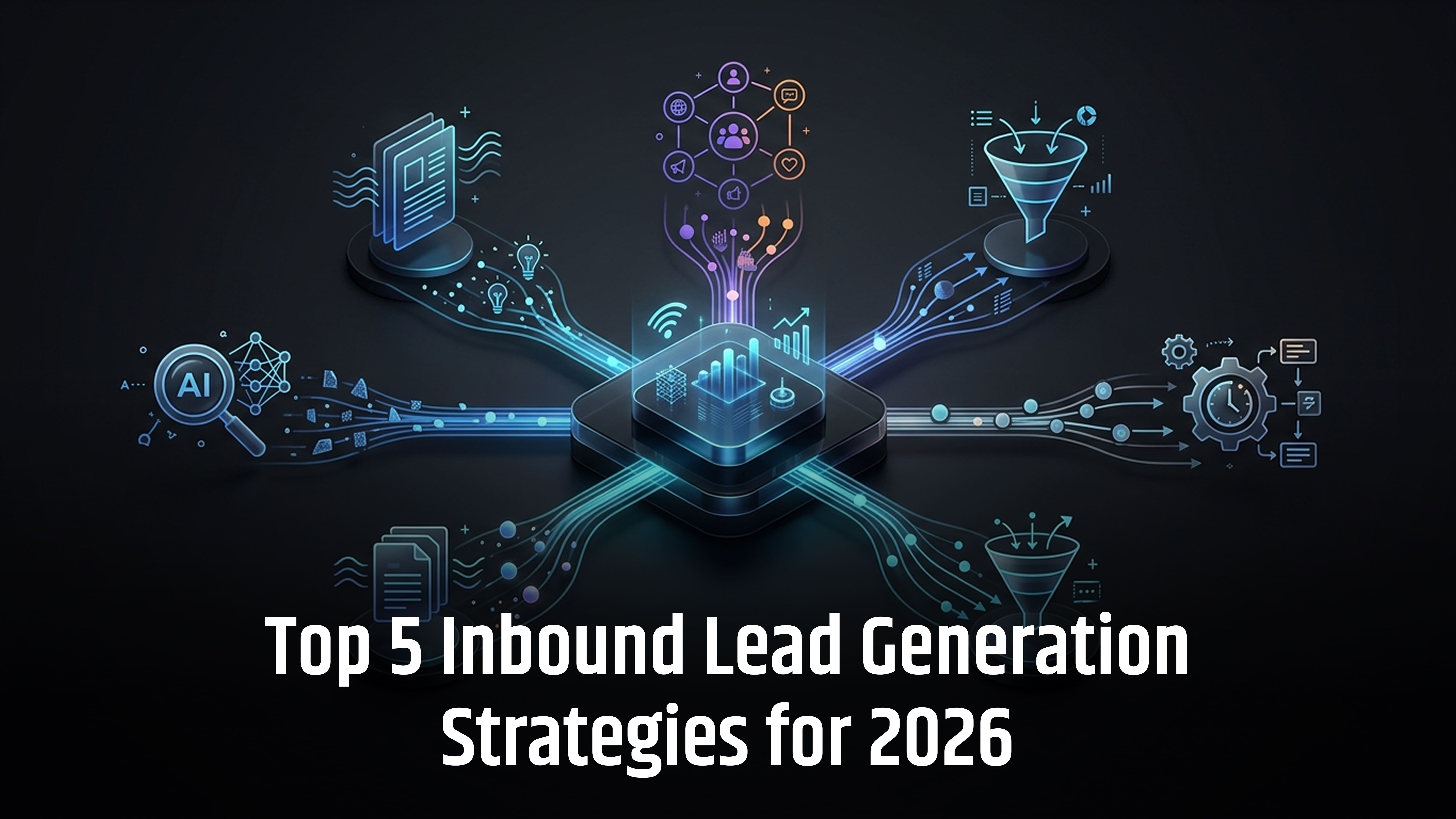
The top 5 inbound lead generation strategies for 2026 include SEO, AI search optimisation, content marketing, lead magnets, landing pages, webinars, email marketing, case studies, community building and marketing automation.
These strategies help businesses attract potential customers, build trust and convert website visitors into qualified leads.
With the growth of Google AI Overviews, ChatGPT and AI-powered search, businesses need to create helpful, authoritative and well-structured content that answers user queries and supports the buyer journey.
What is Inbound Lead Generation?
Inbound lead generation is the process of attracting potential customers through useful content, SEO Services, websites, social media, email and other digital channels, then converting interested visitors into leads.
Common inbound channels include:
- SEO and blog content
- Landing pages and lead magnets
- Case studies and guides
- Webinars and video
- Email marketing
- Social media and online communities
- Free tools, templates and calculators
- AI and conversational search
The typical journey is:
Problem → Search → Content → Website → Engagement → Lead → Nurturing → Customer
In 2026, inbound lead generation also means creating content that is easy for both people and AI search platforms to understand and trust.
The 5 best inbound lead generation strategies for 2026
These 5 inbound lead generation strategies for 2026 can help businesses attract, engage and convert potential customers through SEO, content, AI search and digital channels.
1. AI Search Optimisation (AEO)
Create content that is easy for Google AI Overviews, AI Mode, ChatGPT and other AI search platforms to understand and reference. Use clear answers, reliable sources, original insights and well-structured content rather than repeating keywords.
- Answer key questions directly.
- Use clear headings and short sections.
- Add original research and expert opinions.
- Keep business and author information accurate and up to date.
2. Website Visitor Identification
B2B visitor identification tools can help businesses understand which companies are visiting their website, even when visitors do not complete a form. Tools such as Dealfront can provide company-level information that can be connected with CRM and sales workflows.
- Identify companies showing buying interest.
- Track important page visits and repeat visits.
- Connect visitor data with your CRM.
- Create relevant follow-up workflows.
3. Search Intent and Cornerstone Content
Create comprehensive content based on search intent and customer problems, rather than focusing only on keyword volume. Build cornerstone pages supported by related articles that cover a topic from different angles.
- Match content to informational, commercial and transactional intent.
- Cover related questions naturally.
- Build topic clusters and internal links.
- Update important content when information changes.
4. Middle-of-Funnel Lead Magnets
Offer useful resources that help potential customers make decisions. Practical templates, checklists, calculators, audits and research reports can work better than generic newsletter sign-ups when they match the visitor's intent.
- Create resources around real customer problems.
- Keep forms simple.
- Match the lead magnet to the page topic.
- Follow up with relevant educational content.
5. LinkedIn Authority and Social Selling
Use LinkedIn to share useful insights from founders and subject matter experts. Focus on answering industry questions, explaining problems and sharing genuine experience instead of posting constant promotional content.
- Share original research and opinions.
- Repurpose useful website content into short posts.
- Engage with relevant industry discussions.
- Use LinkedIn Lead Gen Forms where appropriate to reduce conversion friction.
Inbound Lead Generation Funnel for 2026
An inbound lead generation funnel shows how a potential customer moves from discovering a problem to researching solutions, evaluating providers and eventually becoming a lead or customer.
In 2026, businesses should create content for each stage instead of focusing only on people who are ready to buy.
1. Awareness: Attract the Right Audience
The journey starts when a person identifies a problem or needs more information. They may not yet know which product or service can help them.
At this stage, focus on educational content that answers basic questions and builds awareness.
Useful content includes:
- SEO blog posts
- Educational videos
- Industry reports
- Beginner's guides
- Social media posts
Example search: How to generate B2B leads
2. Problem Research: Help Them Understand the Options
Once the person understands the problem, they start researching different methods and approaches. Your content should explain the problem in more detail and help them understand their options.
Useful content includes:
- Detailed guides
- Webinars
- Checklists
- Expert articles
- Comparison guides
Example search: Inbound vs outbound lead generation
3. Solution Research: Show How You Can Help
At this stage, the potential customer has defined their problem and is looking for specific solutions. They may compare tools, services or different approaches.
This is where commercial content becomes more important.
Useful content includes:
- Solution comparison pages
- Product or service pages
- Case studies
- Implementation guides
- Product demonstrations
Example search: Best inbound lead generation software
4. Evaluation: Build Trust Before the Decision
The buyer is now comparing different providers and looking for evidence that a solution is suitable for their needs. Clear information and genuine customer evidence can help them make an informed decision.
Useful content includes:
- Pricing and plans
- Customer case studies
- Reviews and testimonials
- Frequently asked questions
- Technical documentation
- Product demonstrations
At this stage, remove unnecessary friction and make important information easy to find.
5. Conversion: Make the Next Step Clear
The buyer is ready to take action. Your website should provide a clear and relevant way to move forward.
Common conversion actions include:
- Book a meeting
- Request a quote
- Request a product demo
- Start a free trial
- Contact sales
- Make a purchase
The conversion does not always have to be a sales call. For some businesses, a free trial, consultation, quote request or useful downloadable resource may be the more appropriate next step.
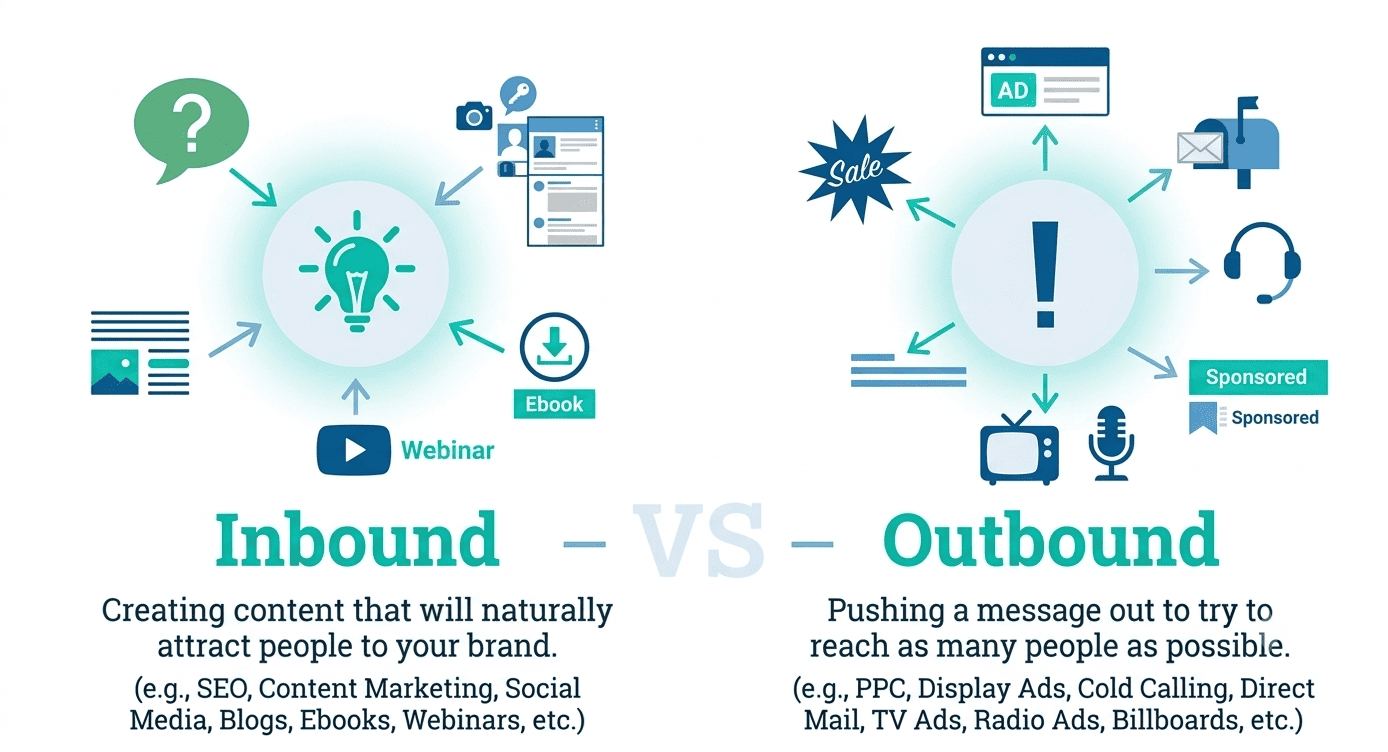
Inbound lead generation vs outbound lead generation
Inbound and Outbound lead generation are different approaches, but businesses do not necessarily need to choose only one.
|
Inbound lead generation |
Outbound lead generation |
|
Attracts people through content and search |
Reaches people directly |
|
Often supports longer buying journeys |
Can create faster initial contact |
|
Uses SEO, content, email and communities |
Uses direct outreach, advertising and sales activity |
|
Builds an owned content library |
Relies more heavily on active campaigns |
|
Can continue attracting visitors after publication |
Usually requires continued campaign activity |
|
Strong for research-driven buyers |
Useful when a defined audience needs to be reached |
How AI Is Changing Inbound Lead Generation in 2026
AI is changing both content creation and online search. Businesses can use AI for research, content planning, editing and repurposing, but the final content should remain accurate, useful and human-focused.
With Google AI Overviews, AI Mode and other AI search platforms, content needs to answer questions clearly and provide original information. The best approach is simple: create content for people first, while making it easy for search engines and AI systems to understand.
How to Improve E-E-A-T
Improve Experience, Expertise, Authoritativeness and Trustworthiness (E-E-A-T) by:
- Adding real examples and first-hand experience.
- Showing the author's expertise and credentials.
- Supporting claims with reliable sources.
- Using original research and data where possible.
- Keeping information accurate and up to date.
- Avoiding unsupported claims, fake reviews and guaranteed results.
Semantic SEO for Inbound Lead Generation
Semantic SEO focuses on the meaning and context behind a topic rather than repeating the same keyword.
For inbound lead generation, naturally cover related concepts such as:
SEO, content marketing, AI search, Google Search Console, AI Overviews, lead nurturing, marketing automation, CRM, landing pages, lead magnets, email marketing, search intent, topic clusters, conversion rate optimisation, first-party data and buyer journey.
Also answer related questions such as how to generate inbound leads, how SEO generates leads, what inbound leads are, how to nurture leads and how to measure inbound lead generation.
The goal is to build complete, useful content, not to repeat keywords unnecessarily.
Google Search Console and AI Visibility in 2026
Google Search Console is useful for tracking how your website appears in Google Search and AI-powered search features. In 2026, businesses can monitor search performance, queries, pages and visibility across generative search experiences.
Track:
- Search queries and impressions
- Organic clicks and pages
- AI search visibility
- Countries and devices
- Changes in performance over time
The key takeaway is simple: SEO visibility now extends beyond traditional search results to AI-powered and multimodal search experiences.
Technical SEO Still Important
Content can only generate organic leads if search engines can access, crawl and understand your website.
Check:
- Indexability and robots.txt
- XML sitemap
- Canonical URLs
- Internal links
- Page speed and mobile usability
- HTTPS
- Structured data
- Broken links and redirects
- Duplicate pages
Google's AI search guidance continues to recommend standard technical SEO practices. AI search features rely on content that can be crawled, indexed and retrieved from Google Search.
Add Structured Data Where It Makes Sense
Structured data helps search engines understand what a page represents. For blog content, Article or BlogPosting schema can provide details such as:
- Headline
- Author
- Publication and modification dates
- Image
- Publisher
Use structured data to describe the page accurately, not as a ranking shortcut. Make sure the markup matches information that is visible and relevant on the page.
Conclusion
The top 5 inbound lead generation strategies for 2026 help businesses attract, engage and convert the right audience. These include SEO, AI search optimisation, content marketing, lead magnets, landing pages, email marketing, LinkedIn, webinars and marketing automation.
Strong lead generation needs more than website traffic. You need helpful content, technical SEO, clear CTAs, lead nurturing and performance tracking. Your content should also be easy for Google and AI search platforms to understand.
Want more qualified leads from your website? WOWinfotech can help. We create tailored inbound marketing, SEO and lead generation strategies based on your business goals.
Ready to grow your inbound leads? Contact WOWinfotech today.
FAQs
Contact us to get a digital strategy
Contact us for digital strategy guidance.