
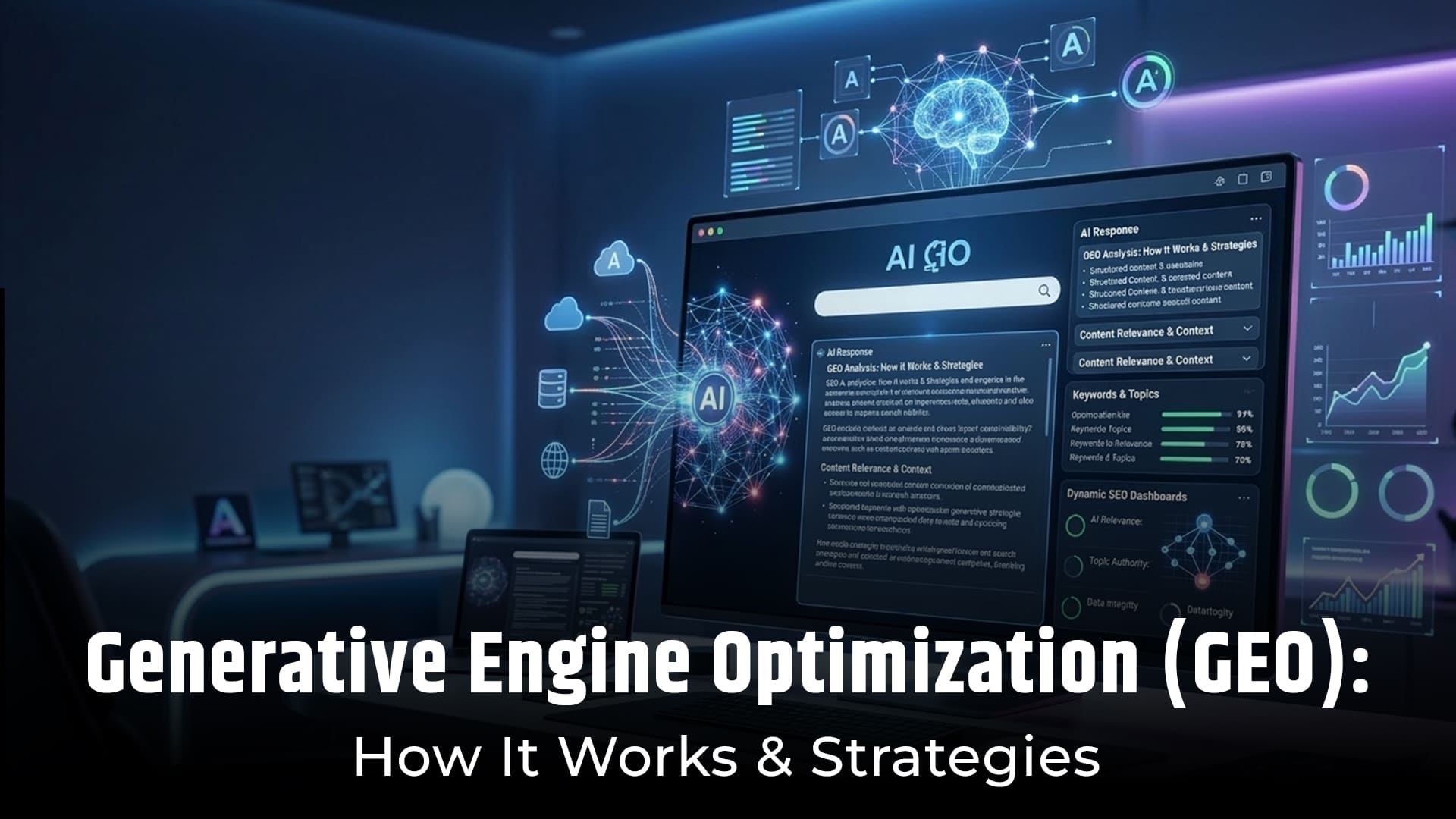
Generative Engine Optimization (GEO) is the process of optimizing website content so that AI search engines and generative AI tools can understand, trust, and reference it in their answers.
Instead of only ranking webpages in traditional search results, GEO helps your content appear inside AI-generated responses from tools like ChatGPT, Google Gemini, Perplexity AI, and Microsoft Copilot.
GEO works by improving content clarity, entity relevance, topical authority, and structured information, making it easier for AI systems to retrieve and cite your content when answering user questions.
Generative Engine Optimization (GEO)
Definition:
Generative Engine Optimization (GEO) is the process of optimizing online content so that AI-powered search engines can find, understand, and cite it in their generated answers.
Example:
If someone asks: “What are the best strategies for GEO?”
An AI tool may generate an answer using information from several websites. If your content is well-optimized for GEO, the AI may include your website as a source.
Why GEO is Important in 2026
AI search tools are becoming a major way people find information online. Instead of searching on Google Search, users often ask AI assistants directly.
Reasons Why GEO Is Important
- AI search is growing quickly
- Users prefer instant answers
- AI tools summarize multiple sources
- Websites need visibility inside AI responses
- Traditional SEO alone is no longer enough
Businesses that adapt early will gain a strong visibility advantage in AI search results.
GEO vs SEO: What’s the Difference?
Here is an explanation of the difference between GEO and SEO
|
Feature |
SEO |
GEO |
|
Goal |
Rank web pages |
Get cited by AI |
|
Search Results |
List of links |
AI-generated answers |
|
Focus |
Keywords |
Meaning and entities |
|
Content Style |
Keyword optimized |
Structured and informational |
|
Success Metric |
Traffic |
AI mentions and citations |
In simple terms:
- SEO helps people find your page
- GEO helps AI use your content in answers
Both strategies work best together.
How Generative Engine Optimization Works
Generative AI tools use large language models and natural language understanding to generate answers.
Here is how GEO works step by step.
- AI Collects Information: AI systems analyze data from websites, articles, and trusted sources.
- Content is Interpreted: AI evaluates the meaning and context of the content using Natural Language Processing.
- Entities Are Recognized: AI identifies important concepts like:
- Brands
- Technologies
- Topics
- people
- Content Is Ranked for Relevance: Information that is clear, structured, and trustworthy is more likely to be used.
- AI Generates an Answer: The system creates a summarized response based on the most reliable sources. If your page is optimized well, your content may become part of that response.
Elements of GEO-Optimized Content
To rank in AI answers, your content must follow certain principles.
1. Clear Definitions
AI prefers content that explains topics clearly.
Example:
Generative Engine Optimization is the practice of optimizing content for AI-driven search engines so they can understand and cite it in answers.
This type of sentence often appears in featured snippets.
2. Well Structured Content
Use clear headings like:
- H1 – Main topic
- H2 – Major sections
- H3 – Subtopics
Structured content helps AI scan and extract information easily.
3. Topic Depth
A strong GEO article should cover:
- definition
- How it works
- strategies
- benefits
- comparisons
- FAQs
This shows topical authority.
4. Semantic Keywords
Instead of repeating the same keyword, include related terms like:
- AI search
- answer engines
- conversational search
- AI content optimization
- generative search
This improves semantic relevance.
5. Entity-Based SEO
Entities help AI understand relationships between topics.
Examples of GEO entities include:
- ChatGPT
- Google Gemini
- Perplexity AI
- Microsoft Copilot
- Artificial Intelligence
- Natural Language Processing
These entities help AI understand context and topic relationships.
10 Practical GEO Strategies for 2026
1. Answer Questions Clearly
AI systems prioritize content that directly answers questions.
Example:
Question: What is GEO?
Answer: Generative Engine Optimization is the process of optimizing content so AI systems can use it in generated responses.
2. Use Question-Based Headings
Headings like these improve AI discoverability:
- What is GEO?
- How does GEO work?
- Why is GEO important?
3. Build Topical Authority
Publish multiple articles related to AI search such as:
- GEO strategies
- AI SEO
- answer engine optimization
- LLM optimization
This builds expertise.
4. Create High-Quality Long Content
AI prefers detailed and informative content. Articles between 1500 and 3000 words often perform well.
5. Add Lists and Tables
Lists and tables improve the chance of appearing in featured snippets.
6. Write in Simple Language
Clear writing helps both readers and AI models understand the content. Avoid complicated jargon.
7. Use Real Examples
Explain ideas with practical scenarios.
Example: A marketing agency writing a detailed GEO guide may be referenced when AI answers digital marketing questions.
8. Maintain Content Accuracy
Update your articles regularly to keep information fresh. AI systems prioritize current and reliable information.
9. Optimize for Conversational Queries
Users now search using natural language.
Examples:
- “How does generative search work?”
- “What is GEO in SEO?”
Write content that answers these queries.
10. Strengthen Trust Signals
Add:
- expert authors
- credible sources
- data and research
- updated statistics
This improves content trustworthiness.
Common GEO Mistakes to Avoid
-
Keyword Stuffing
Repeating the same keyword too many times reduces readability.
-
Thin Content
Short and shallow content rarely becomes an AI reference.
-
Poor Structure
Unorganized articles are harder for AI to interpret.
-
Outdated Information
AI prefers updated and accurate content.
Conclusion
Generative Engine Optimization (GEO) is the next evolution of digital search optimization.
As AI tools like ChatGPT and Google Gemini change how people find information, websites must adapt their content strategies.
The best GEO content: answers questions clearly, uses structured headings, includes relevant entities, provides deep topic coverage, builds authority and trust
By combining SEO, semantic content, and GEO strategies, websites can increase their chances of appearing in AI answers, featured snippets, and future search experiences.
Frequently Asked Questions
- ChatGPT
- Google Gemini
- Perplexity AI
- Microsoft Copilot
Contact us to get a digital strategy
Contact us for digital strategy guidance.