
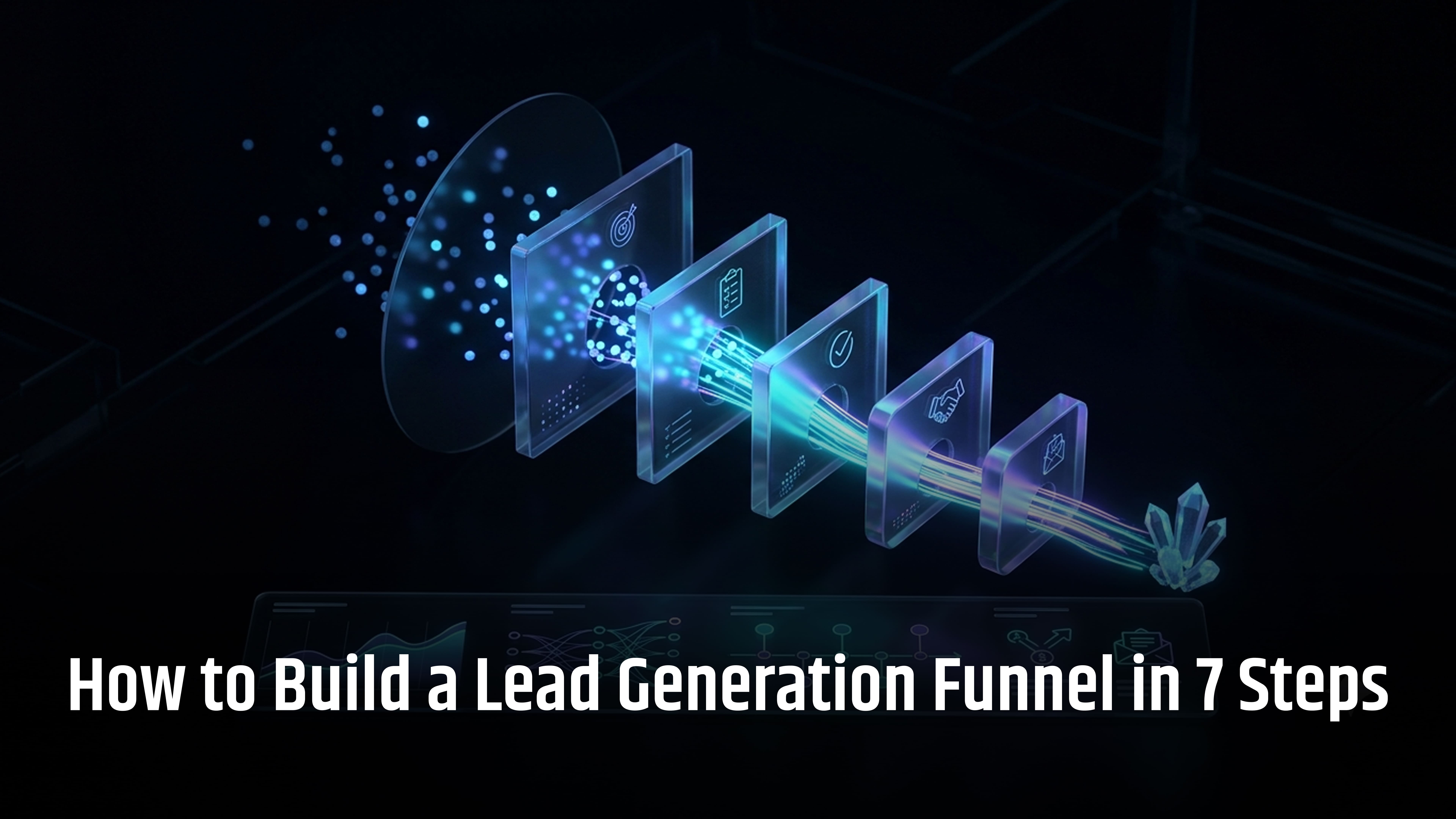
A lead generation funnel is a structured system that guides a person from first discovering your business to becoming a qualified lead. It works by matching content and actions to user intent, starting with awareness and moving step by step towards conversion using tools like SEO content, landing pages, lead magnets, email follow-ups, and CRM tracking.
In 2026, a lead generation funnel is typically divided into three stages: Top of Funnel (TOFU) for awareness, Middle of Funnel (MOFU) for consideration, and Bottom of Funnel (BOFU) for conversion. Each stage is designed to answer the user’s next question, reduce friction, and improve lead quality rather than just increasing traffic volume.
Lead Generation Funnel Steps
A step-by-step process that guides potential customers from awareness to conversion through structured stages of engagement, capture, nurturing, and qualification.
Step 1: Define your audience and search intent
Identify who your customers are, what they search for, and what problem they want to solve using intent mapping and buyer personas.
Before building anything, you need to define:
- Who you are targeting (B2B, B2C, niche segment)
- What problem they are trying to solve
- What search terms they use on Google
- What stage of awareness they are in
In SEO terms, this is called intent mapping:
- Informational intent → blog posts
- Commercial intent → comparisons, guides
- Transactional intent → landing pages, demo pages
Useful entities and frameworks here include:
- Buyer persona
- Jobs-to-be-done (JTBD)
- Customer journey mapping
- Search intent analysis
Without this step, your funnel attracts traffic that does not convert.
Step 2: Build awareness entry points (TOFU)
Create visibility through SEO, content, and social channels that introduce your business to new users without direct selling.
The top of the funnel is where people first discover you. In 2026, the strongest TOFU channels are:
- SEO blog content (Google search traffic)
- YouTube educational content
- Social media short-form content
- Paid search (Google Ads)
- Referral traffic
The goal here is not selling. It is visibility. Typical TOFU content types:
- “What is…” guides
- Problem-solving articles
- Industry explanations
- Checklists and templates
Example:
“How to reduce customer churn”
“What is lead scoring in CRM systems”
This stage is heavily influenced by Google E-E-A-T principles:
- Experience
- Expertise
- Authoritativeness
- Trustworthiness
Step 3: Create a lead capture system (landing pages + forms)
Convert visitors into leads using landing pages, forms, and lead magnets that exchange value for contact information.
Common lead capture tools:
- Landing pages
- Email signup forms
- Pop-ups (used carefully)
- Lead magnets
Lead magnet examples:
- PDF guides
- Templates
- Free tools
- Webinars
This step converts anonymous visitors into known contacts.
Modern funnels reduce friction:
- fewer form fields
- clear value exchange
- mobile-first design
Step 4: Segment leads using behaviour signals
Group leads based on actions like page visits and engagement levels to understand intent and readiness to buy.
In 2026, segmentation is based on:
- Pages visited
- Time on site
- Content downloaded
- Email engagement
- Intent signals (pricing page visits, demo clicks)
This is where lead scoring systems are used.
Typical segmentation:
- Cold lead (first visit)
- Warm lead (engaged content)
- Hot lead (high intent actions)
Tools often used:
- CRM systems (HubSpot, Salesforce-style platforms)
- Marketing automation tools
- Behaviour tracking analytics
Step 5: Build a nurturing system (MOFU email + content)
Educate and build trust with leads using emails, case studies, and content that helps them evaluate solutions.
The middle funnel focuses on trust-building:
- Email sequences
- Case studies
- Comparison guides
- Educational content
- Retargeting ads
This stage answers questions like:
- “Is this solution right for me?”
- “What are the alternatives?”
- “What results can I expect?”
A strong nurturing system improves conversion without increasing traffic.
Step 6: Create conversion points (BOFU)
Turn qualified leads into customers using clear calls to action such as demos, trials, and contact forms.
Common conversion actions:
- Booking a call
- Requesting a demo
- Starting a free trial
- Filling a contact form
Key BOFU pages:
- Pricing pages
- Product/service pages
- Demo landing pages
- Case study pages
At this stage, clarity matters more than persuasion:
- clear offer
- clear outcome
- low friction CTA
Step 7: Connect CRM, tracking, and optimisation loop
Track performance across the funnel using CRM and analytics tools to improve conversions and reduce drop-offs.
You need to track:
- Traffic sources (SEO, ads, referrals)
- Conversion rates per stage
- Drop-off points
- Cost per lead (CPL)
- Lead-to-customer rate
Core systems used:
- CRM (customer relationship management)
- Analytics tools (Google Analytics-style platforms)
- Attribution tracking systems
This step turns your funnel into a continuous optimisation system, not a static setup.
Lead generation funnel structure
A linear flow that moves users from traffic to conversion through TOFU, MOFU, and BOFU stages.
TOFU → MOFU → BOFU
- Traffic (SEO, ads, social)
- Landing page visit
- Lead capture (form/email)
- Email nurturing
- Qualification (lead scoring)
- Conversion (sale/demo/trial)
Common mistakes in lead funnels
- Targeting broad, unqualified traffic
- No clear lead magnet
- Weak landing page messaging
- No follow-up system
- No segmentation
- No tracking or attribution
Most funnel failures happen after traffic is generated, not before.
E-E-A-T considerations (why this structure works)
This structure follows:
- Experience: real funnel stages used in modern marketing systems
- Expertise: aligns with standard TOFU/MOFU/BOFU models
- Authority: consistent with CRM and SEO industry frameworks
- Trust: focuses on clarity, tracking, and measurable outcomes
Search engines in 2026 prioritise structured, intent-based content that clearly maps user problems to solutions.
Conclusion
A lead generation funnel in 2026 is not just a marketing concept it is a structured system that connects traffic, behaviour, and conversion tracking. The most effective funnels are built around clear audience targeting, SEO-driven entry points, lead capture systems, nurturing sequences, and measurable optimisation.
If each step is aligned properly, the funnel becomes a predictable system for generating qualified leads instead of random website traffic.
FAQ
Contact us to get a digital strategy
Contact us for digital strategy guidance.