
Growing an e-commerce business is becoming more challenging as competition increases and customer expectations continue to evolve. Many online stores struggle with low traffic, poor conversion rates and rising customer acquisition costs.
A strong digital marketing strategy can help solve these challenges. By combining SEO, content marketing, email marketing, social media, paid advertising and customer retention strategies, ecommerce businesses can attract the right audience, increase sales and build long-term growth.
This guide explains everything you need to know about digital marketing for e-commerce business in 2026, including the latest trends, essential channels and best practices for sustainable success.
Digital Marketing for E-commerce Business: Strategies That Work in 2026
Running an e-commerce business has become more competitive than ever. Consumers have more choices, search behaviour is changing, and artificial intelligence is influencing how people discover products.
A successful e-commerce marketing strategy is no longer about simply running ads or posting on social media. Businesses need a combination of:
- Search engine optimisation (SEO)
- Content marketing
- Email marketing
- Social media marketing
- Paid advertising
- Conversion rate optimisation
- Customer retention
- AI-driven personalisation
- Mobile optimisation
- Analytics and data tracking
Businesses that combine these channels usually achieve more sustainable growth and better customer loyalty.
Why E-commerce Businesses Need Digital Marketing
Most customers do not make a purchase the first time they visit an online store. They typically go through several stages before becoming loyal buyers, and digital marketing helps businesses connect with customers at each stage of this journey.
Most buyers go through several stages:
1. Awareness
Customers recognise a need or problem and begin searching for information or solutions.
2. Consideration
They research products, compare brands and evaluate different options before making a decision.
3. Decision
Customers choose the product or brand that best meets their needs and complete the purchase.
4. Retention
Satisfied customers return for repeat purchases and help build long-term business growth.
Digital marketing supports every stage of this customer journey.
Benefits include:
- Higher visibility in search engines.
- Better brand awareness.
- Increased conversions.
- Lower customer acquisition costs.
- Long-term organic traffic.
- Improved customer loyalty.
E-commerce SEO: The Foundation of Long-Term Growth
Search engine optimisation remains one of the most important channels for e-commerce businesses.
SEO helps online stores appear in Google when customers search for products.
Examples include:
- Running shoes for beginners
- Organic skincare products
- Wireless gaming headphones
- Kitchen storage containers
Types of E-commerce SEO
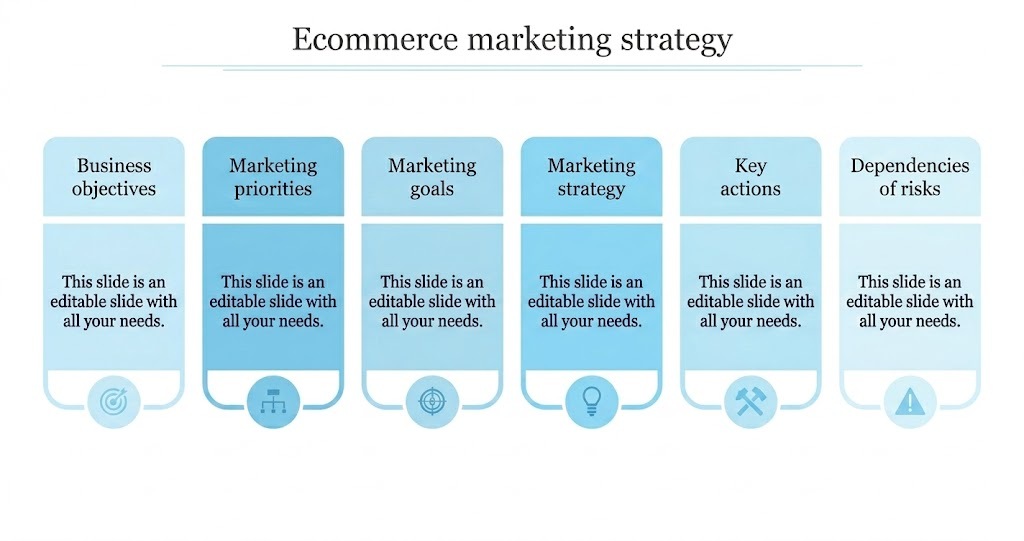
Different types of e-commerce SEO work together to improve search visibility, attract organic traffic and enhance the overall shopping experience.
On-Page SEO
Optimises individual pages and product listings to help search engines understand your content and improve rankings.
Optimising:
- Product titles
- Meta descriptions
- Headings
- Internal links
- Product descriptions
Technical SEO
Focuses on website performance and structure to ensure search engines can crawl, index and display your pages effectively.
Improving:
- Website speed
- Mobile usability
- Crawlability
- Indexing
- Structured data
Content SEO
Uses valuable content to answer customer questions, target relevant keywords and drive organic traffic.
Creating:
- Buying guides
- Blog articles
- FAQs
- Comparison pages
Off-Page SEO
Builds website authority and trust through backlinks, brand mentions and digital PR activities.
Building authority through:
- Backlinks
- Brand mentions
- Digital PR
Keyword Research for E-commerce
Keyword research helps e-commerce businesses understand customer search intent and target the terms most likely to drive qualified traffic and sales.
1. Informational Keywords
These keywords target users looking for answers, guides or educational content before making a purchase.
- How to choose running shoes
- Best skincare routine
- What is whey protein
2. Commercial Keywords
These keywords attract customers who are comparing products and evaluating different options.
- Best wireless earbuds
- Top office chairs
3. Transactional Keywords
These keywords target users with strong purchase intent who are ready to buy a product.
- Buy office chair online
- Running shoes UK
4. Long-Tail Keywords
Long-tail keywords often convert better because they reflect specific intent.
Examples:
- Best coffee machine for small kitchens
- Lightweight hiking boots for women
Content Marketing for E-commerce
Content marketing builds authority and trust. Helpful content can answer customer questions before they buy.
1. Buying Guides
How to choose a laptop
2. Product Comparisons
Air fryer vs oven
3. Tutorials
How to clean leather shoes
4. Problem-Solving Articles
Why does my skin feel dry after washing?
Google rewards content that genuinely helps users.
Product Page Optimisation
Product pages are among the most important pages on an e-commerce website.
1. Unique Product Descriptions
Avoid duplicate manufacturer content.
2. Benefits
Explain how the product solves problems.
3. Specifications
Include dimensions, materials and features.
4. Images
Use multiple high-quality images.
5. Reviews
Customer reviews improve trust and conversions.
6. FAQs
Answer common questions directly.
Email Marketing for E-commerce
Email marketing remains one of the highest-performing channels.
1. Welcome Emails
Introduce your brand.
2. Abandoned Cart Emails
Recover lost sales.
3. Product Recommendation Emails
Suggest related products.
4. Seasonal Campaigns
Promote offers during holidays.
5. Re-engagement Emails
Bring inactive customers back.
Good email marketing focuses on relevance rather than frequency.
Social Media Marketing for E-commerce
Social media platforms help brands reach customers where they spend their time.
1. Instagram
Instagram is ideal for fashion, beauty, fitness and lifestyle brands, allowing businesses to promote products through photos, videos, Stories and influencer collaborations.
2. Facebook
Facebook helps businesses reach wider audiences through organic posts, groups and targeted advertising campaigns that support customer engagement and sales.
3. Pinterest
Pinterest is particularly effective for home décor, food, fashion and DIY brands, as users often search for inspiration and products with strong purchase intent.
4. YouTube
YouTube enables brands to educate and influence customers through tutorials, product demonstrations, reviews and long-form video content.
Consistency matters more than posting everywhere.
Paid Advertising
Paid advertising provides immediate visibility.
1. Google Ads
Captures search intent.
2. Shopping Ads
Show products directly in search results.
3. Facebook Ads
Useful for audience targeting.
4. Instagram Ads
Effective for visual products.
5. Retargeting Campaigns
Bring visitors back to complete purchases.
Paid campaigns work best when supported by strong SEO and content.
Conversion Rate Optimisation (CRO)
Getting traffic is only part of the process. Conversion rate optimisation helps turn visitors into buyers.
Methods include:
- Faster page speed.
- Simpler checkout.
- Clear calls to action.
- Product reviews.
- Better images.
- Live chat support.
- Trust badges.
- Mobile optimisation.
Small improvements can produce significant increases in revenue.
Mobile Commerce is Essential
Most e-commerce traffic now comes from smartphones.
A mobile-friendly website should provide:
- Fast loading times.
- Responsive design.
- Easy navigation.
- Simple checkout.
- Mobile payment options.
Poor mobile experience often leads to abandoned carts.
Video Marketing for E-commerce
Video content continues to grow in importance.
Popular formats include:
- Product demonstrations.
- Unboxing videos.
- Tutorials.
- Customer testimonials.
- Behind-the-scenes content.
- Short-form videos.
Videos help customers understand products and increase confidence before purchase.
Customer Retention Strategies
Acquiring customers is expensive. Keeping existing customers is usually more profitable.
Effective retention methods include:
1. Loyalty Programmes
Reward repeat purchases.
2. Personalised Recommendations
Suggest relevant products.
3. Email Automation
Stay connected after purchase.
4. Exceptional Customer Service
Build long-term trust.
5. Subscription Models
Create recurring revenue.
AI and Personalisation in E-commerce Marketing
Artificial intelligence is becoming increasingly important in 2026.
AI helps businesses with:
- Product recommendations.
- Customer segmentation.
- Chatbots.
- Email automation.
- Predictive analytics.
- Dynamic pricing.
However, AI should support human expertise rather than replace it. Recent trends show that trust and authentic experiences remain essential.
Omnichannel Marketing
Customers move across several touchpoints before purchasing.
They may discover products through:
- Google Search
- YouTube
- Marketplaces
Omnichannel marketing ensures a consistent experience across all channels.
Analytics and Performance Tracking
Without measurement, optimisation becomes difficult.
|
Metric |
Purpose |
Why It Matters for E-commerce |
|
Traffic Sources |
Understand where visitors come from. |
Helps identify which channels (organic search, social media, email, paid ads, referrals) drive the most traffic. |
|
Conversion Rate |
Measure how many visitors complete a purchase. |
Shows how effectively your website turns visitors into customers. |
|
Average Order Value (AOV) |
Track spending behaviour. |
Helps increase revenue by understanding how much customers spend per order. |
|
Customer Lifetime Value (CLV) |
Measure long-term profitability. |
Indicates the total value a customer brings throughout their relationship with your business. |
|
Return on Ad Spend (ROAS) |
Evaluate advertising performance. |
Measures how much revenue is generated for every pound spent on advertising. |
|
Cart Abandonment Rate |
Identify checkout problems. |
Reveals where customers leave before completing a purchase, helping improve the buying process. |
Emerging E-commerce Marketing Trends for 2026
Several trends are shaping e-commerce marketing:
1. AI Search and Answer Engines
Content should answer questions naturally and cover topics comprehensively.
2. Voice Search Optimisation
Use conversational phrases and FAQ sections.
3. Short-Form Video
Video remains one of the highest engagement formats.
4. Hyper-Personalisation
Customers expect relevant experiences.
5. Generative Engine Optimisation (GEO)
Brands increasingly optimise content for AI-powered search experiences.
6. First-Party Data
Businesses rely more on their own customer data for marketing.
Common Mistakes E-commerce Businesses Make
- Ignoring SEO.
- Depending entirely on paid ads.
- Publishing thin content.
- Using duplicate product descriptions.
- Neglecting mobile users.
- Having a slow website.
- Ignoring customer reviews.
- Not tracking performance.
- Focusing only on new customers.
Conclusion
Digital marketing for ecommerce business in 2026 is about creating useful experiences rather than chasing algorithms.
The strongest ecommerce brands combine:
- SEO
- Content marketing
- Email marketing
- Social media
- Paid advertising
- Customer retention
- AI-assisted personalisation
- Conversion optimisation
Businesses that focus on helping customers, building trust and answering search intent are more likely to achieve sustainable growth and visibility across Google and AI-driven search platforms. Looking to grow your online store? Contact the WOWinfotech team to get started.
Frequently Asked Questions
Contact us to get a digital strategy
Contact us for digital strategy guidance.