

Search Engine Optimisation (SEO) has become more complex than ever. Businesses, marketers, and website owners are expected to manage keyword research, content optimisation, technical SEO audits, internal linking, schema markup, competitor analysis, rank tracking, and content updates while keeping pace with frequent algorithm changes.
As search engines continue to prioritise search intent, topical authority, user experience, and E-E-A-T, many SEO teams struggle to maintain consistent performance without spending countless hours on repetitive tasks.
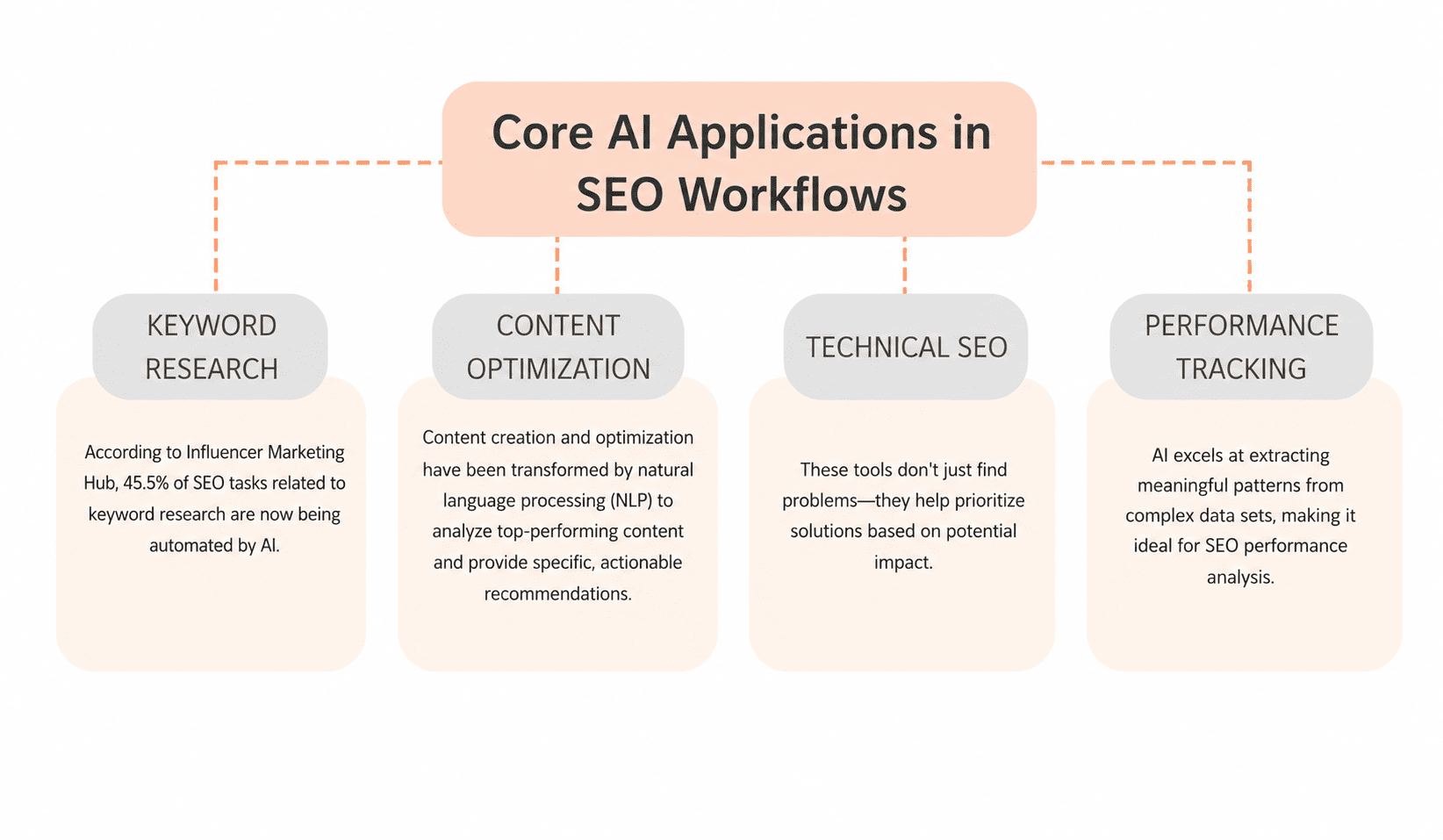
This is where Artificial Intelligence (AI) is transforming modern SEO workflows. AI-powered tools can automate time-consuming activities such as keyword clustering, content briefs, technical audits, on-page optimisation, and performance reporting, allowing SEO professionals to focus on strategy, expertise, and content quality.
This guide explains how to automate SEO tasks with AI and create a more efficient SEO workflow for better search visibility.
What is AI SEO Automation?
AI SEO automation is the use of Artificial Intelligence to automate repetitive SEO tasks such as keyword research, content optimisation, technical audits, and reporting. It helps improve efficiency and allows SEO professionals to focus on strategy and creating high-quality content.
The goal is to automate repetitive work so SEO professionals can focus on:
- SEO strategy
- User experience
- Brand authority
- Content quality
- Conversion optimisation
- Search intent alignment
SEO Tasks You Can Automate Using AI
Automating repetitive SEO tasks with AI can improve efficiency while ensuring consistency across your optimisation efforts.
1. Keyword Research
Keyword research remains one of the most time-consuming SEO activities.
AI tools can:
- Discover keyword opportunities
- Analyse search intent
- Group related keywords
- Identify long-tail keywords
- Find question-based searches
- Detect emerging trends
Example
Instead of manually sorting hundreds of keywords, AI can organise them into semantic clusters such as:
Primary Topic: AI SEO
Related clusters:
- AI SEO tools
- AI content optimisation
- AI keyword research
- SEO automation software
- AI technical SEO
- Generative Engine Optimisation
This creates a stronger topical structure for content planning.
2. Keyword Clustering and Topic Mapping
Keyword clustering is one of the highest-value SEO automations available today.
AI can group thousands of keywords based on:
- Search intent
- Semantic similarity
- User behaviour patterns
- Topical relevance
This helps build:
- Topic clusters
- Pillar pages
- Content hubs
- Semantic content networks
A well-structured topical map improves internal linking and topical authority.
3. Content Brief Creation
Creating SEO briefs manually can take hours.
AI can automatically generate:
- Target keywords
- Search intent analysis
- Competitor insights
- Recommended headings
- Entity suggestions
- Frequently Asked Questions
- Internal linking opportunities
Human review is still necessary, but the initial research phase becomes much faster.
4. Content Optimisation
AI content optimisation tools can analyse:
- Heading structure
- Keyword coverage
- Missing entities
- Semantic relationships
- Readability
- Search intent alignment
Rather than focusing on keyword density, modern AI tools evaluate topical completeness and contextual relevance.
Important entities for this topic include:
- Search Engine Optimisation (SEO)
- Artificial Intelligence (AI)
- Natural Language Processing (NLP)
- Machine Learning
- Large Language Models (LLMs)
- Google Search
- Google Search Console
- Schema Markup
- Topic Clusters
- E-E-A-T
5. Internal Link Optimisation
Internal linking is often overlooked.
AI systems can:
- Find orphan pages
- Suggest contextual links
- Improve topic clusters
- Strengthen semantic relationships
- Distribute authority more effectively
Many SEO professionals consider internal linking one of the easiest high-impact tasks to automate.
6. Technical SEO Audits
AI can automatically identify:
- Broken links
- Redirect issues
- Duplicate content
- Missing metadata
- Crawl errors
- Indexation problems
- Slow-loading pages
Tools such as Screaming Frog now include AI-powered capabilities that assist with content analysis and semantic evaluation alongside technical audits.
7. Meta Title and Description Generation
Writing metadata for hundreds of pages is repetitive.
AI can generate:
- SEO titles
- Meta descriptions
- Open Graph tags
- Social snippets
Human review remains important to ensure accuracy and brand consistency.
8. Schema Markup Creation
Structured data helps search engines understand content.
AI can generate:
- Article Schema
- FAQ Schema
- Product Schema
- Local Business Schema
- Review Schema
- Breadcrumb Schema
This reduces implementation time and improves search visibility.
9. Rank Tracking and Reporting
Manual reporting wastes valuable time.
AI-powered dashboards can automate:
- Keyword ranking reports
- Traffic summaries
- Competitor tracking
- Visibility trends
- Technical SEO reports
Reports can be delivered automatically without manual spreadsheet work.
10. Content Refresh Automation
Older content often loses visibility.
AI can identify:
- Declining pages
- Outdated information
- Missing subtopics
- New search trends
- Emerging user questions
Content refresh workflows are becoming one of the most effective SEO automation strategies in 2026.
SEO Tasks That Should Not Be Fully Automated
While AI can automate many repetitive SEO tasks, some areas still require human expertise, judgement, and experience. The most effective SEO strategies combine AI efficiency with human oversight to ensure accuracy, quality, and trustworthiness.
1. SEO Strategy
AI can analyse data and identify patterns, but it cannot fully understand business objectives, market positioning, customer behaviour, or brand identity.
It cannot fully understand:
- Business goals
- Market positioning
- Customer psychology
- Brand differentiation
2. Experience-Based Content
Google's E-E-A-T guidelines value real-world experience, making human insights, case studies, original research, and industry expertise essential.
AI cannot replace:
- Case studies
- Original research
- Personal insights
- Industry expertise
3. Relationship-Based Link Building
Although AI can support outreach efforts, building high-quality backlinks still depends on trust, networking, and genuine relationships.
4. Editorial Quality Control
Human review remains crucial to ensure content accuracy, fact-checking, brand voice consistency, compliance, and overall trustworthiness.
Human editors remain essential for:
- Accuracy
- Fact-checking
- Tone of voice
- Compliance
- Trustworthiness
A Practical AI SEO Workflow for 2026
A structured AI SEO workflow helps streamline repetitive tasks while ensuring content quality and search intent remain a priority.
Step 1: Topic Discovery
Use AI to uncover search demand, trending topics, and common user questions.
- Search demand
- Emerging trends
- User questions
Step 2: Keyword Clustering
Organise related keywords into semantic clusters based on search intent.
Step 3: Content Brief Creation
Generate detailed content briefs with outlines, entities, FAQs, and internal linking opportunities.
Generate:
- Outline
- Entities
- FAQs
- Internal links
Step 4: Draft Creation
Use AI to create initial drafts and refine them with human expertise and original insights.
Human experts should improve:
- Expertise
- Examples
- Accuracy
- Original insights
Step 5: Content Optimisation
Review content for semantic coverage, search intent alignment, and entity relevance.
- Semantic coverage
- Search intent
- Entity relevance
Step 6: Technical Validation
Run automated SEO audits to identify and fix technical issues.
Step 7: Publishing
Ensure schema markup, metadata, and internal links are properly implemented before publishing.
- Schema implementation
- Internal linking
- Metadata optimisation
Step 8: Performance Monitoring
Track rankings, organic traffic, user engagement, and visibility across AI-powered search platforms.
- Rankings
- Traffic
- Engagement
- AI search visibility
Best AI Tools for SEO Automation in 2026
Choosing the right AI tools is an important step towards improving productivity and maintaining a consistent SEO strategy.
|
Tool |
Best For |
Key Uses |
|
ChatGPT |
Content creation and planning |
Content briefs, article outlines, topic research, content expansion |
|
Long-form content and analysis |
Long-form writing, content analysis, research summaries |
|
|
Perplexity |
Research and fact-checking |
Real-time research, source verification, competitor insights |
|
Ahrefs |
SEO research and link building |
Keyword research, backlink analysis, competitor research |
|
Semrush |
All-in-one SEO management |
Site audits, position tracking, content planning, competitor analysis |
|
Screaming Frog |
Technical SEO |
Technical SEO audits, crawl analysis, metadata reviews |
|
Surfer SEO |
On-page SEO optimisation |
Content optimisation, semantic SEO, keyword coverage analysis |
|
Google Search Console |
SEO performance monitoring |
Search performance tracking, indexing analysis, search query insights |
AI SEO and Generative Engine Optimisation (GEO)
SEO in 2026 goes beyond traditional search engines. Content should also be optimised for AI-powered search platforms and answer engines to improve visibility and discoverability.
GEO focuses on:
- Building topical authority and semantic relevance
- Creating structured, easy-to-understand content
- Establishing expertise and source credibility
- Improving entity relationships for AI search engines
Common AI SEO Mistakes
Avoid these mistakes:
- Publishing AI-generated content without editing
- Ignoring search intent
- Overusing keywords
- Automating strategy decisions
- Creating thin content at scale
- Neglecting E-E-A-T signals
- Forgetting internal linking
- Using AI without fact-checking
Conclusion
AI SEO automation is changing the way businesses approach search engine optimisation. Rather than replacing SEO professionals, AI helps streamline repetitive tasks such as keyword research, content optimisation, technical SEO audits, and reporting, allowing teams to focus on strategy, user experience, topical authority, and E-E-A-T. The most effective SEO strategies in 2026 combine AI-powered workflows with human expertise to create high-quality content that performs across Google Search and AI-powered search platforms.
If you're looking to automate your SEO processes and build a sustainable organic growth strategy, WOWinfotech can help. Our team combines AI-driven SEO, technical expertise, and content strategies to improve search visibility, increase organic traffic, and strengthen your online presence. Get in touch with Wowinfotech to discover how AI-powered SEO can support your business growth.
Frequently Asked Questions
Contact us to get a digital strategy
Contact us for digital strategy guidance.