
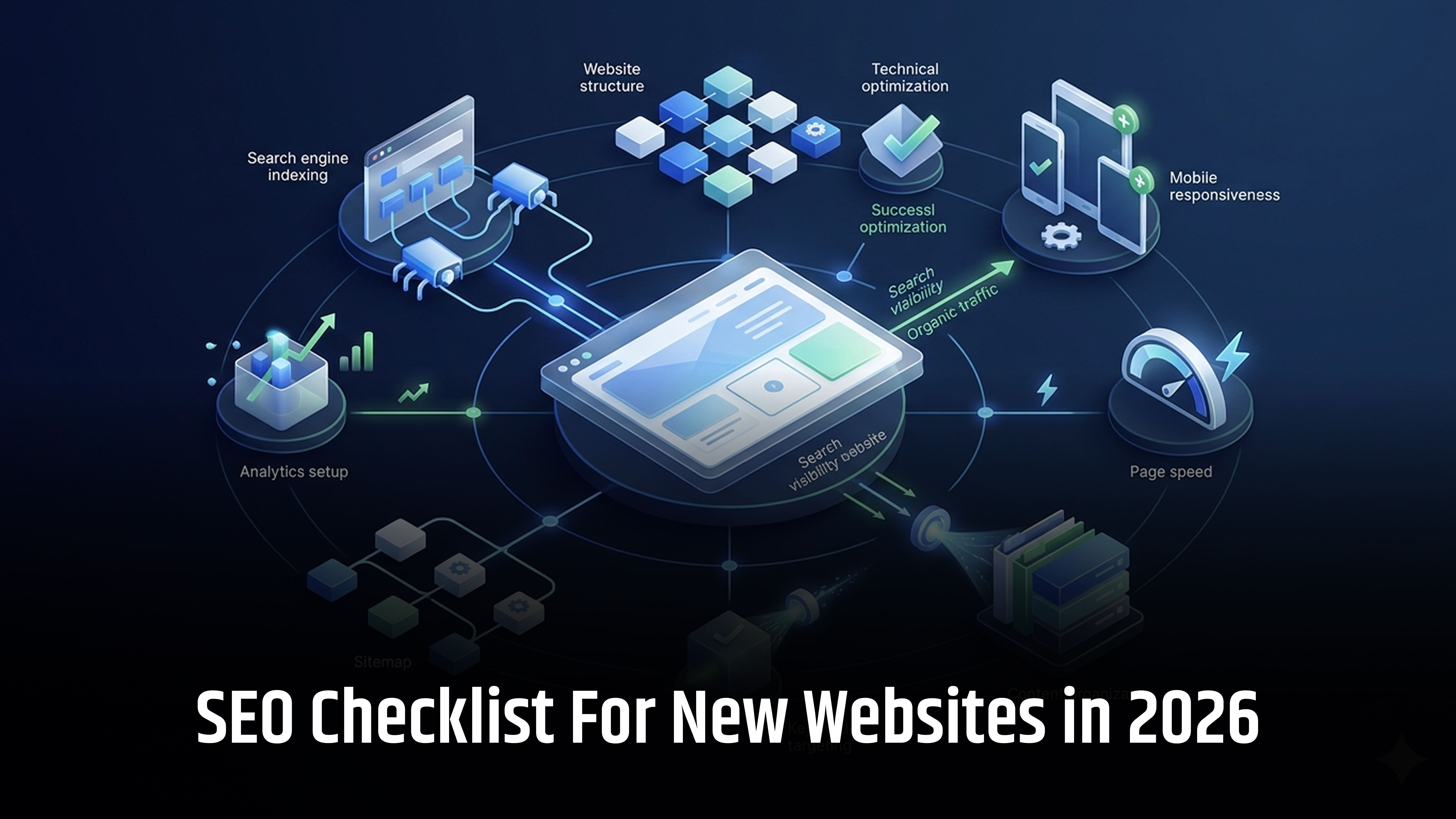
Launching a new website is easier than ever, but getting it to rank in Google and AI-powered search results is becoming increasingly challenging. Many new websites struggle with indexing issues, poor site structure, slow loading speeds, weak content, and a lack of authority. As a result, even high-quality websites often fail to attract organic traffic because search engines cannot properly understand their content or trust their expertise.
This is where a well-planned SEO strategy becomes essential. In 2026, SEO goes beyond keywords and focuses on semantic search, entities, E-E-A-T, technical optimisation, and AI search visibility. By following a complete SEO checklist, new websites can improve crawlability, build topical authority, enhance user experience, and create content that search engines and AI systems can easily understand.
This guide covers everything you need to build a strong SEO foundation and increase your chances of achieving long-term organic growth.
SEO in 2026: What Changed
SEO has shifted from keyword-based optimisation to semantic and entity-based search.
updates in 2026:
- INP (Interaction to Next Paint) replaced older responsiveness metrics
- AI Overviews now extract structured answers directly from content
- “Entity-first indexing” is more important than keyword density
- Generative Engine Optimisation (GEO) affects visibility in AI answers
- Content freshness and updates influence rankings heavily
Search engines now focus on:
- meaning
- context
- credibility
- structured information
SEO Checklist For New Websites (2026)
A quick overview of the key SEO areas, their focus, and the actions needed to build a search-optimised and AI-ready website.
|
SEO Area |
Focus |
What You Should Do |
|
Technical SEO |
Crawlability, indexing, speed |
Submit sitemap, fix robots.txt, improve Core Web Vitals, ensure mobile-first design |
|
On-Page SEO |
Content optimisation |
Use proper titles, headings (H1-H3), meta tags, and internal linking |
|
Semantic SEO |
Meaning & entities |
Use related entities, topic clusters, and natural language content |
|
E-E-A-T |
Trust & authority |
Add author info, real experience, credible sources, and updated content |
|
AI SEO (GEO/AEO) |
AI visibility |
Add FAQs, structured data, and clear answer-based content |
|
Off-Page SEO |
Authority building |
Earn quality backlinks and brand mentions from relevant sites |
|
UX SEO |
User experience |
Improve navigation, readability, and page speed for better engagement |
Technical SEO Checklist (Foundation Layer)
Technical SEO ensures your website can be crawled, rendered, and indexed properly.
1. Crawlability & Indexing
- XML sitemap created and submitted to Google Search Console
- robots.txt configured correctly
- Important pages are not blocked
- No orphan pages (every page internally linked)
- Proper HTTP status codes (200, 404, 301)
Search engines must be able to access your pages without barriers
2. Site Architecture
- Clear hierarchy (Home → Categories → Pages)
- URL structure is short and readable
- Important pages within 3 clicks from homepage
- Breadcrumb navigation implemented
Example: Home → Services → SEO Services
3. Core Web Vitals (2026 standard)
Focus on:
- LCP (loading performance)
- INP (interaction speed)
- CLS (visual stability)
Slow websites lose rankings even with good content.
4. Mobile & Security
- Mobile-first responsive design
- HTTPS enabled
- No mixed content errors
- Secure headers configured
On-Page SEO Checklist
Proper on-page SEO helps search engines understand your content and improves its relevance, structure, and visibility in search results.
1. Required elements:
- Unique title tag (keyword + intent)
- Meta description (clear summary, not keyword stuffing)
- One H1 per page
- Structured H2/H3 hierarchy
- Internal links to related pages
- Clean URL slug
2. Example structure:
Title: SEO Checklist for New Websites 2026
H1: SEO Checklist For New Websites in 2026
H2: Technical SEO
H2: Content Strategy
H2: E-E-A-T
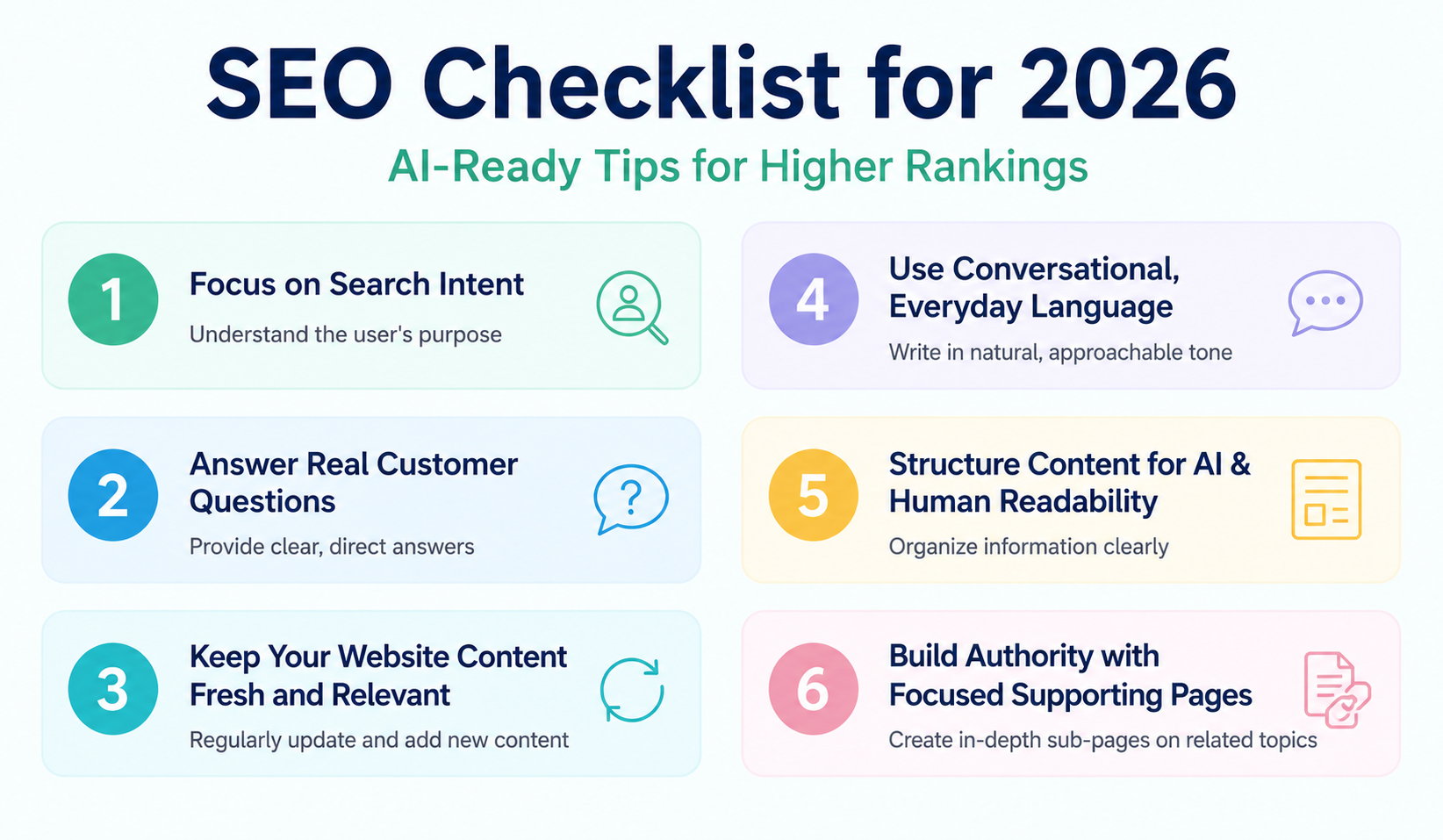
Content & Semantic SEO Checklist
Build content around entities, search intent, and topical relevance to help search engines better understand and rank your website.
1. Use entities (important in 2026)
Entities help search engines understand the context and relationships between topics, improving content relevance and semantic understanding.
Examples:
- Google Search Console
- Core Web Vitals
- XML Sitemap
- robots.txt
- E-E-A-T
- Schema.org
- INP metric
2. Topic clusters
Organising related content into topic clusters strengthens topical authority and helps search engines discover content connections.
Create clusters like:
- SEO Basics
- Technical SEO
- Content SEO
- Link Building
- AI SEO (GEO/AEO)
3. Search intent alignment
Aligning content with user intent ensures that pages answer the right queries and satisfy search expectations.
Match content to intent:
- Informational → guides, blogs
- Commercial → comparisons
- Transactional → service pages
4. Content quality signals
High-quality content with clear explanations, updated information, and natural language improves user experience and search visibility.
- Clear explanations
- Real examples
- Updated information
- No filler content
- Natural language (NLP optimised writing)
E-E-A-T & Trust Signals
Strong E-E-A-T signals demonstrate experience, expertise, authority, and trustworthiness, which are essential for long-term rankings.
- Experience
- Expertise
- Authoritativeness
- Trustworthiness
Improve E-E-A-T by:
- Adding author profiles
- Showing real experience
- Citing reliable sources
- Updating content regularly
- Using real-world examples
Websites with weak trust signals struggle to rank even with good SEO.
AI Search Optimisation (GEO / AEO)
AI Search Optimisation (GEO/AEO) helps content become more discoverable and understandable for AI-powered search engines and answer systems.
To optimise:
1. Make content extractable
Structuring content with clear headings, FAQs, and concise answers helps search engines and AI systems easily understand and surface information.
- Use short answer blocks
- Use bullet summaries
- Add FAQs
- Use clear headings
2. Structured data is essential
Structured data provides additional context that improves content understanding and increases visibility in search and AI-generated results.
- Article schema
- FAQ schema
- Organisation schema
3. Optimise for AI crawlers
Allowing AI crawlers to access your website helps improve discoverability across emerging AI search platforms.
Modern SEO also considers:
- GPTBot
- PerplexityBot
- ClaudeBot
Allowing AI crawlers improves visibility in AI systems
Link Building & Authority
High-quality backlinks and brand mentions strengthen website authority and signal trust to search engines.
Focus on:
- Contextual links from relevant sites
- Editorial backlinks
- Mentions in niche content
- Brand citations
Avoid:
- spam directories
- Irrelevant link exchanges
UX & Performance SEO
A fast, user-friendly website improves engagement and helps search engines identify content as valuable and relevant.
- Fast loading pages (<3>
- Easy navigation
- Clean layout
- High readability
- Low bounce rate
Search engines interpret poor UX as low-quality content.
Structured Data & Schema
Implementing schema markup helps search engines understand content relationships and enhances eligibility for rich results.
Important schema types:
- Article schema
- FAQPage schema
- Breadcrumb schema
- Organisation schema
Structured data improves eligibility for rich results.
SEO Tools for New Websites
Recommended tools in 2026:
- Google Search Console (indexing & performance)
- Google Analytics 4 (user behavior)
- Screaming Frog (technical SEO audits)
- Ahrefs / Semrush (keyword & backlinks)
- SurferSEO (content optimisation)
Common SEO Mistakes for New Websites
Avoid:
- launching without sitemap
- blocking pages in robots.txt
- thin content pages
- duplicate titles
- no internal linking
- ignoring mobile optimisation
- not tracking analytics
Conclusion
SEO in 2026 is driven by semantic understanding, entity-based indexing, and AI search systems. A new website must be built with strong technical SEO, structured content, and clear E-E-A-T signals so that search engines and AI tools can correctly interpret its meaning and relevance. When content is organised into topic clusters and supported with schema, internal linking, and user-focused structure, it becomes easier to rank and get cited across modern search platforms.
If you want a properly structured, SEO-ready website built for Google and AI search visibility, you can connect with WOWinfotech for end-to-end website and SEO implementation focused on long-term organic growth.
FAQ
Contact us to get a digital strategy
Contact us for digital strategy guidance.