Imagine your competitors capturing thousands of long-tail searches while you focus on a few pages. That’s where Programmatic SEO (pSEO) changes the game. Instead of creating content one page at a time, it uses data, templates, and automation to efficiently build hundreds or thousands of search-focused pages.
This approach helps businesses target entire keyword patterns rather than individual queries. By combining structured data with scalable systems, Programmatic SEO turns content into a growth engine, driving consistent organic traffic and visibility without relying solely on manual effort.
What Is Programmatic SEO?
Programmatic SEO (pSEO) is a strategy that uses automation, data, and templates to create large numbers of optimised web pages. Instead of building pages manually, it targets multiple keyword variations at scale. This approach helps businesses rank for long-tail searches, expand visibility, and drive consistent organic traffic growth efficiently.
How Programmatic SEO Works
Programmatic SEO works by combining keyword data, templates, and automation to create multiple optimised pages at scale. It helps websites target large keyword sets efficiently while maintaining structure, consistency, and search intent alignment.
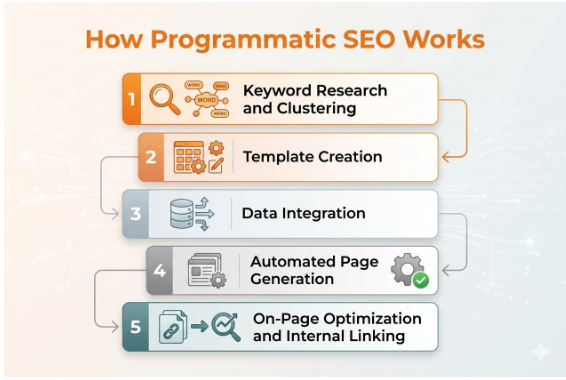
Keyword Research and Clustering
The process starts with identifying large sets of related keywords. These are grouped into clusters based on patterns like location, product type, or user intent, allowing Programmatic SEO to target multiple search variations effectively.
Template Creation
Next, SEO-friendly page templates are designed. These templates include structured sections such as headings, meta tags, and content blocks that remain consistent while allowing dynamic data insertion for each page.
Data Integration
Structured data from databases, spreadsheets, or APIs is connected to templates. This data fills each page with unique, relevant information, ensuring pages are not identical and provide value to users.
Automated Page Generation
Once templates and data are ready, pages are generated automatically in bulk. This allows websites to publish hundreds or thousands of pages quickly, each targeting a specific keyword variation.
On-Page Optimisation and Internal Linking
Each page is optimised with proper keywords, headings, and metadata. Internal linking is added to connect pages, helping search engines crawl and index them efficiently while improving overall site structure.
Benefits of Programmatic SEO
Programmatic SEO helps businesses scale content creation and target thousands of search queries efficiently. It enables faster growth in organic traffic by covering entire keyword clusters with minimal manual effort.
- Scalable Content Creation: Programmatic SEO allows you to create hundreds or thousands of pages using templates and data, reducing manual workload while maintaining consistency across pages.
- Long-Tail Keyword Coverage: It helps target highly specific search queries that are easier to rank for, bringing in qualified traffic with higher intent and better conversion potential.
- Faster Organic Growth: By publishing pages at scale, websites can quickly expand their search presence and capture traffic across multiple keyword variations.
- Cost-Effective Strategy: Once the system is set up, Programmatic SEO reduces content production costs compared to creating each page manually.
- Improved Search Visibility: It increases chances of ranking for diverse queries, helping brands appear in more search results and reach a wider audience.
- Consistent Structure and Optimisation: Using templates ensures each page follows SEO best practices, improving overall site performance and user experience.
Programmatic SEO vs Traditional SEO
Programmatic SEO focuses on scaling content using automation and data, while traditional SEO relies on manual content creation. Both aim to improve rankings, but their approach, speed, and execution differ significantly.
|
Aspect |
Programmatic SEO |
Traditional SEO |
|
Approach |
Uses automation, templates, and structured data to create pages at scale |
Focuses on manually creating and optimising individual pages |
|
Content Creation |
Bulk page generation based on keyword patterns |
One-by-one content creation with detailed research |
|
Keyword Targeting |
Targets large sets of long-tail keywords efficiently |
Targets selected keywords with deeper focus |
|
Scalability |
Highly scalable, can generate thousands of pages quickly |
Limited scalability due to manual effort |
|
Time & Effort |
Faster execution with lower manual workload |
Time-consuming and resource-intensive |
|
Personalisation |
Uses dynamic data to create relevant variations |
Relies on manually written personalised content |
|
Risk Factors |
Risk of thin or duplicate content if not optimised properly |
Lower risk due to controlled content quality |
|
Best Use Cases |
Marketplaces, SaaS, directories, and large websites |
Blogs, service pages, and brand-focused content |
|
Results |
Rapid traffic growth when executed correctly |
Steady and consistent growth over time |
Examples of Programmatic SEO
Programmatic SEO is widely used to scale content and capture multiple search queries efficiently. Businesses leverage it to create targeted pages that serve specific user intents and boost organic traffic.
Location Pages (e.g., “Service in [City]”)
Location-based Programmatic SEO targets local search queries at scale. Examples include:
- “Plumber in London”
- “Dentist in Manchester”
- “Coffee Shops in Birmingham”
Product/Category Pages
E-commerce sites use Programmatic SEO to generate multiple product or category pages quickly. Examples include:
- “Men’s Running Shoes”
- “Smartphones Under £500”
- “Organic Skincare Products”.
Directory & Marketplace Pages
Marketplaces and directories scale listings using Programmatic SEO. Examples include:
- “Top Restaurants in New York”
- “Freelance Designers by Skill”
- “Hotels in Paris with Pool”
Integration Pages (SaaS)
SaaS companies create pages for integrations or use cases using Programmatic SEO. Examples include:
- “Slack Integration for Project Management Tools”
- “CRM Integration with Shopify”
- “Accounting Software with Xero”
Which Companies Use Programmatic SEO?
Many companies leverage Programmatic SEO to scale content, dominate long-tail keywords, and capture search traffic at scale. From e-commerce to SaaS, programmatic strategies help businesses grow efficiently without manual content creation.
Companies Using Programmatic SEO:
- E-commerce Platforms: Amazon, Etsy – generate product pages for thousands of items.
- Travel & Booking Sites: Booking.com, TripAdvisor – create location and hotel-specific pages automatically.
- Real Estate Portals: Zillow, Realtor.com – scale city and neighborhood property listings.
- SaaS & Tech Companies: HubSpot, Zapier – target multiple use cases and integrations with automated landing pages.
- Marketplaces & Directories: Yelp, Yellow Pages – expand listings for cities, services, and categories.
These companies use programmatic strategies to efficiently capture broad search visibility and long-tail keyword traffic.
Challenges of Programmatic SEO
Programmatic SEO offers scalability and efficiency, but it comes with challenges that can impact search rankings and user experience if not carefully managed. Businesses must address these risks before implementing pSEO strategies.
- Thin or Duplicate Content: Automated pages can lack uniqueness, leading to lower rankings or Google penalties.
- Keyword Cannibalization: Multiple pages targeting similar keywords may compete against each other.
- Technical Complexity: Requires proper templates, data management, and SEO automation tools.
- Maintenance Effort: Large-scale pages need ongoing updates to remain accurate and relevant.
- Indexing Issues: Generating thousands of pages can overwhelm search engines if not structured correctly.
- User Experience Risk: Over-automation may result in generic content that fails to engage visitors.
This ensures your pSEO strategy is both scalable and sustainable.
Conclusion
Programmatic SEO (pSEO) transforms content creation, allowing businesses to target thousands of keywords efficiently without relying on manual effort. It’s a powerful strategy for scaling organic traffic and improving search visibility.
While highly effective, pSEO requires careful planning to avoid duplicate content, indexing issues, and user experience risks. Structured templates, automation, and ongoing maintenance are key to success.
For businesses aiming to dominate long-tail searches and grow organically, Programmatic SEO offers a scalable, data-driven approach that complements traditional SEO, making content growth faster, more efficient, and impactful.
Frequently Asked Questions
Contact us to get a digital strategy
Contact us for digital strategy guidance.