
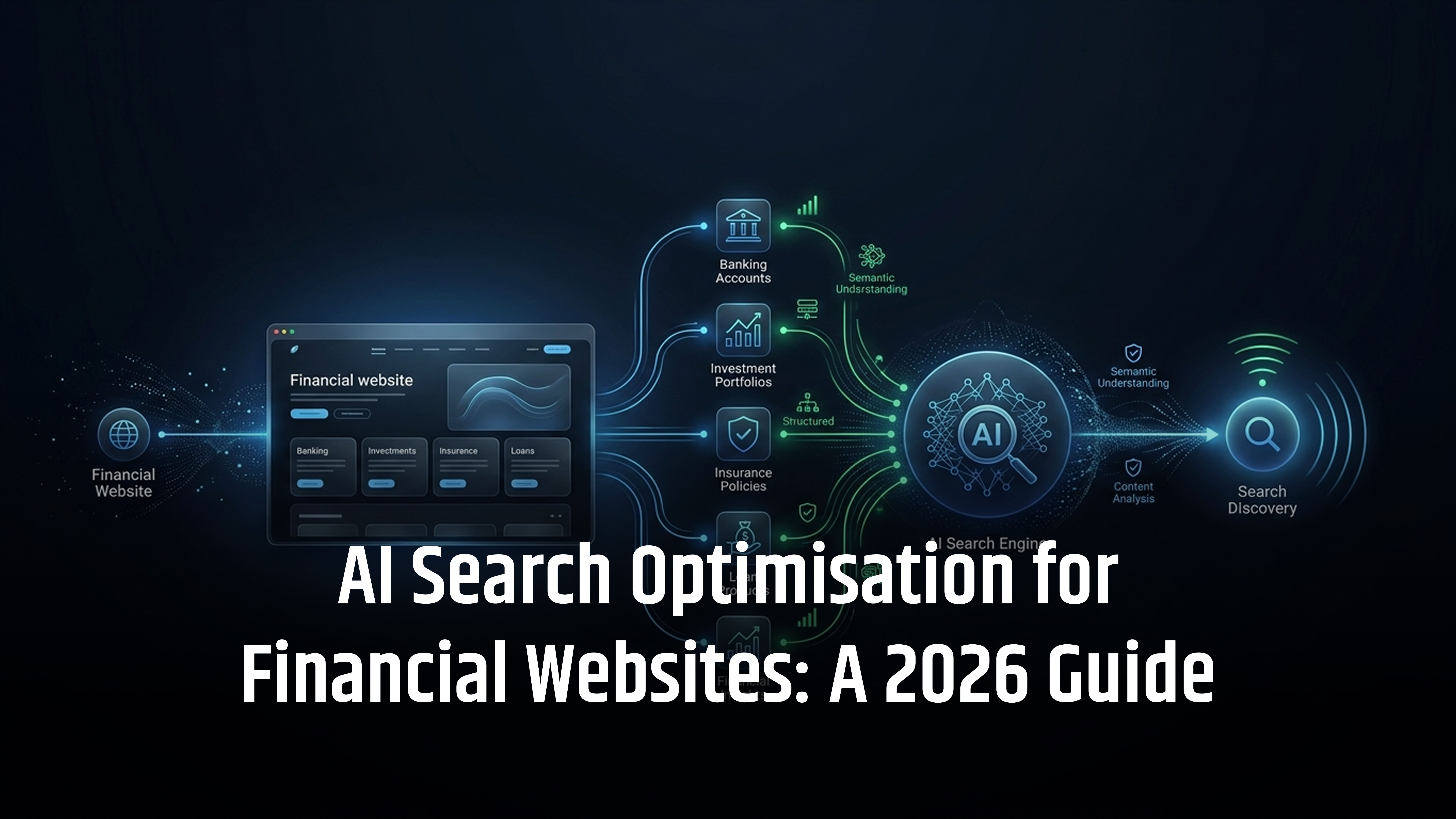
Your next customer may not be choosing a financial provider from ten blue links. They may be asking an AI search tool which provider to trust.
AI Search Optimisation for financial websites helps Google and AI systems find, understand and reference your content. For UK financial businesses, this combines SEO, E-E-A-T, expert content, technical SEO and professional website design and development.
This guide explains how to build a search-ready, trustworthy financial website in 2026 with the help of the right website design and development company in the UK.
What Has Changed in Financial SEO in 2026?
Financial SEO has moved beyond keyword rankings. In 2026, financial website development services need to be visible across Google Search and AI-powered platforms such as AI Overviews, AI Mode and conversational search tools.
Search systems can now combine multiple related searches to build answers. This means financial content needs to do more than target keywords. It should provide clear answers, relevant entities, reliable facts, expert insight, risks and supporting sources.
The focus has shifted from:
“What keyword should I rank for?”
to:
“What does the user need to know, and can my content clearly and reliably answer it?”
This makes semantic SEO, E-E-A-T, expert-led content and trustworthy sources essential for financial websites in 2026.
Why Financial Websites Need a Different Approach
Financial websites cover YMYL topics such as mortgages, loans, investments, pensions, insurance, tax and banking. Incorrect information can affect important financial decisions.
That is why E-E-A-T is important. Financial content should show real expertise, use trusted sources and provide clear, accurate information.
For example, an investment platform guide should explain:
- What the platform does
- Who it may suit
- Fees and charges
- Key risks
- Relevant tax rules
This gives readers and AI search systems the clear, reliable context they need to understand the topic.
AI Search Optimisation vs traditional financial SEO
Traditional SEO still matters.
The difference is that AI search increases the importance of context, entities, relationships and evidence.
|
Traditional financial SEO |
AI search optimisation |
|
Keyword targeting |
Topic and entity coverage |
|
Search rankings |
Search and answer visibility |
|
Backlinks |
Reputation and supporting references |
|
Metadata |
Clear information architecture |
|
Keyword variations |
Natural language and semantic relationships |
|
Blog posts |
Expert-led knowledge resources |
|
Traffic |
Visibility, citations, qualified visits and conversions |
|
Search snippets |
Extractable, well-supported answers |
|
Content freshness |
Reliable update and review process |
|
Domain authority |
Demonstrable topical and organisational authority |
This does not mean keywords no longer important. They still help establish relevance.
But a modern financial website should build topic depth, rather than creating dozens of thin pages that each target a slight keyword variation.
Google specifically warns against creating large quantities of pages simply to manipulate rankings or generative search visibility.
Build Topic Clusters Instead of Isolated Blog Posts
Create topic clusters around your main financial services. For example, a mortgage hub can link to guides on mortgage rates, affordability, deposits, LTV, fees, eligibility and remortgaging.
The goal is not to create pages for every keyword. Create useful content that answers genuine customer questions, then connect related pages with internal links. This helps search engines understand your topical authority.
Understand Search Intent
Match content to what the user wants:
- Informational: “How does a pension work?”
- Commercial: “Investment platform fees”
- Transactional: “Apply for a mortgage”
- Navigational: “FCA register”
Understanding intent helps you create the right page for each stage of the customer journey.
Focus on Business Value, Not Just Search Volume
High search volume does not always mean high business value. A broad query such as “What is a bank?” may attract traffic, while “Open a business bank account” may attract users closer to taking action.
Prioritise search intent, customer needs, commercial value, conversions and topical relevance rather than chasing traffic alone.
E-E-A-T for Financial Websites
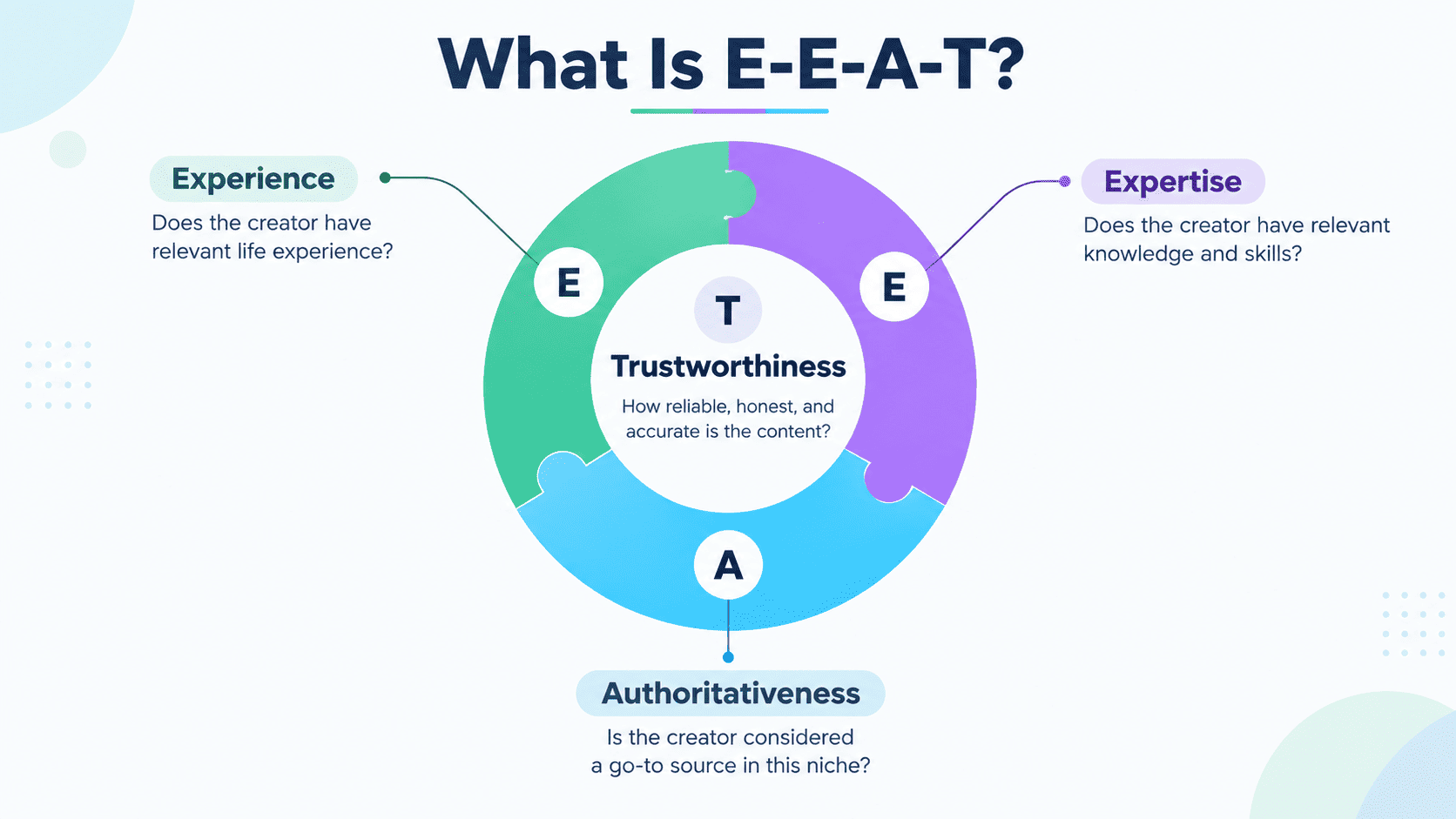
E-E-A-T means Experience, Expertise, Authoritativeness and Trustworthiness. Financial content should demonstrate these qualities through:
- Qualified authors and reviewers
- Relevant professional experience
- Reliable sources
- Clear fees and risks
- Accurate regulatory information
- Publication and review dates
- Transparent business information
The aim is simple: make it clear who created the content, why they are qualified and where the information comes from.
Use Real Financial Expertise
Generic financial content is easy to produce and difficult to differentiate. Involve financial advisers, accountants, compliance professionals and other subject experts.
Use their experience to answer real customer questions, explain common mistakes, clarify risks and provide practical insights. This creates original, useful content that goes beyond information already available online.
Write Answers AI Systems Can Understand
AI systems need context, but clear answers make financial content easier to understand and retrieve.
A useful structure is:
Question
What is a fixed-rate mortgage?
Direct answer
A fixed-rate mortgage keeps the interest rate unchanged for an agreed period. Your rate will not change during the fixed term, although fees, charges and other terms may still apply.
Explanation
Then cover:
- How the rate works
- Typical fixed terms
- Benefits and drawbacks
- Early repayment charges
- What happens when the term ends
- Who it may suit
This structure helps both users and search systems understand the topic. It can also support visibility across Google Search, AI Overviews, AI Mode and conversational search.
Keep the writing natural. Do not create artificial paragraphs simply to make them easier for AI systems to extract.
Use entities, not just keywords
Entities are important to semantic search. for a financial website, relevant entities may include:
Organisations
- Financial Conduct Authority (FCA)
- Prudential Regulation Authority (PRA)
- Bank of England
- HM Revenue & Customs (HMRC)
- Financial Ombudsman Service
- MoneyHelper
- Companies House
Financial products
- Mortgage
- ISA
- Pension
- SIPP
- Credit card
- Personal loan
- Business loan
- Insurance policy
- Investment platform
- Savings account
- Current account
Concepts
- Interest rate
- APR
- Compound interest
- Inflation
- Credit score
- Loan-to-value
- Affordability
- Risk
- Diversification
- Tax relief
- Capital gains
- Liquidity
- Fees
- Charges
People and professional roles
- Financial adviser
- Mortgage adviser
- Accountant
- Investment manager
- Compliance officer
- Financial planner
The important part is not to force these entities into every article. Use them where they genuinely explain the subject.
Build content around the questions people actually ask
Keyword tools are useful, but they should not be the only source of content ideas.
Use:
- Customer support questions
- Sales calls
- Adviser conversations
- Search Console queries
- Site search data
- FAQs
- Complaints
- Product questions
- Industry forums
- Regulatory updates
- Competitor gaps
- Search suggestions
- Related searches
- Expert interviews
This can uncover questions with little traditional search volume but high commercial relevance. For financial services, that can be more valuable than producing hundreds of generic articles.
Financial SEO and Compliance
SEO and compliance should work together. Financial content must consider FCA rules, Consumer Duty, risk disclosures, regulatory information, rates and product claims.
Avoid unsupported claims such as “The UK's best investment platform.” Instead, explain comparison criteria such as fees, features, risks and service.
1. Keep Content Fresh
Financial information changes frequently. Review content when rates, tax rules, regulations, fees or product details change.
Include:
- Published date
- Review date
- Named reviewer
- Reliable sources
2. Technical SEO for AI Search
Strong technical SEO remains essential for AI search. Check:
- Crawlability and indexing
- XML sitemaps
- Canonicals
- Internal links
- Mobile experience
- Search Console errors
Connect related financial pages with descriptive internal links.
3. Structured Data
Use relevant structured data such as Article, Organization, Person, BreadcrumbList and FinancialProduct where appropriate.
Structured data should match visible content. It helps search engines understand pages but is not a ranking shortcut.
4. What about llms.txt?
Google's 2026 guidance says llms.txt is not required for Google Search and does not improve or harm visibility.
Focus first on crawlable content, strong information architecture, expert authorship, reliable sources and technical SEO.
5. Semantic SEO and Keywords
Structure articles around the main question, definitions, related topics, risks, regulation, expert insight, FAQs and sources.
Use the main keyword naturally in the H1, introduction, title and relevant headings. Add related terms such as AI search, financial SEO, E-E-A-T, YMYL, entities and structured data where relevant.
6. External Links
Use authoritative sources such as the FCA, HMRC and GOV.UK to support financial claims and help readers verify information.
Create original financial research
Original research can be particularly useful for both SEO and digital PR.
Examples include:
Mortgage research
- Average mortgage fees
- Regional mortgage trends
- First-time buyer concerns
- Mortgage application questions
Payments research
- Payment failure rates
- Consumer payment preferences
- Fraud trends
- Checkout abandonment
Banking research
- SME banking concerns
- Business account switching
- Banking fee comparisons
Investment research
- Investor information needs
- Common investing misconceptions
- Retail investor behaviour
The research must be methodologically sound.
Explain:
- Sample size
- Method
- Dates
- Geography
- Limitations
- Data source
Original data is more useful than publishing another article summarising ten other articles.
AI-Generated Content and Financial SEO
AI can support financial content workflows by helping with outlines, topic research, FAQs, internal linking and content gaps.
However, it should not replace financial expertise. AI-generated content can contain outdated information, inaccurate statistics, regulatory errors or missing risk information.
For financial websites, the best approach is:
AI assistance + human expertise + fact-checking + compliance review.
Track AI Search Optimisation
One of the biggest problems with AI search is measurement.
A traditional SEO report might show:
- Impressions
- Clicks
- Rankings
- Organic sessions
- Conversions
AI search introduces additional questions:
- Is the brand being mentioned?
- Is the website being cited?
- Which pages are referenced?
- Which competitors appear in AI answers?
- Which topics generate citations?
- Which prompts produce visibility?
- Does AI visibility lead to website visits?
- Does it influence branded search?
- Does it influence leads?
Google introduced a Generative AI performance report in Search Console in 2026, providing a new way to understand performance in generative AI features.
That makes first-party search data increasingly important.
Financial AI search visibility should be tracked by topic
Do not only track whether the company appears for its brand name. Create a topic-level monitoring list.
For example:
Banking
- Best business bank account
- Business banking for small companies
- Business current account fees
Mortgages
- Best mortgage for first-time buyers
- Mortgage affordability
- Fixed vs variable mortgage
Investments
- Best investment platform
- Investment platform fees
- Investing for beginners
Insurance
- Business insurance options
- Professional indemnity insurance
- Life insurance comparison
Then monitor:
- Brand mentions
- URL citations
- Competitor mentions
- Source diversity
- Accuracy of descriptions
This provides a much clearer picture of AI search presence.
Conclusion
AI Search Optimisation for financial websites is not about chasing algorithms or using AI tricks. It is about creating accurate, useful, expert-led and technically accessible content that people and search systems can understand and trust.
In 2026, financial businesses need strong SEO, E-E-A-T, semantic content, technical performance, expert reviews, reliable sources and regular content updates. Just as importantly, they need a professional website that is fast, secure, mobile-friendly and built around user experience and compliance.
Need a Financial Website Built for Search and Growth?
WOWinfotech helps financial businesses with website design and development, SEO and AI Search Optimisation in the UK.
From designing a modern financial website to developing secure, scalable digital platforms and optimising content for search and AI-powered discovery, our team can help you build a stronger digital presence.
Want to make your financial website more visible, credible and conversion-focused? Talk to WOWinfotech today.
FAQ
Contact us to get a digital strategy
Contact us for digital strategy guidance.