
AI models are moving beyond simply answering questions. The newer generation is increasingly expected to reason through complex problems, use tools and complete tasks across digital environments. That is where GPT-6 Astra differs from the GPT-5.6 family.
In simple terms, GPT-6 Astra is OpenAI’s newer flagship model, built for more demanding, multi-step work. Compared with GPT-5.6 Sol, it brings stronger performance in advanced reasoning, computer use, agentic coding, scientific workflows, long-context tasks and cybersecurity. GPT-5.6, meanwhile, remains a capable model family that includes Sol, Terra and Luna, with different performance and cost levels.
So, GPT-6 Astra is not simply a faster version of GPT-5.6. Its main difference is the ability to combine reasoning with tools and computer interaction to handle more complex end-to-end tasks. But how significant is the difference in real-world use? Let’s compare the two models.
GPT-6 Astra and GPT-5.6: At a Glance
A quick comparison of GPT-6 Astra and GPT-5.6, covering their features, capabilities, context window, performance and pricing.
|
Feature |
GPT-6 Astra |
GPT-5.6 Sol |
|
Generation |
GPT-6 |
GPT-5.6 |
|
Position |
Frontier flagship |
Flagship professional model |
|
Release |
September 2026 |
July 2026 |
|
Context window |
1.05 million tokens |
1.05 million tokens |
|
Maximum output |
128,000 tokens |
128,000 tokens |
|
Knowledge cutoff |
30 April 2026 |
16 February 2026 |
|
ARC-AGI-3 |
99.9% |
7.8% |
|
FrontierMath Tier 4 |
97.6% |
83.0% |
|
Terminal-Bench 4.0 |
57.9% |
37.3% |
|
DeepSWE v1.1 |
74.1% |
72.7% |
|
Computer use |
Yes |
No |
|
Function calling |
Yes |
Yes |
|
Structured outputs |
Yes |
Yes |
|
Image input |
Yes |
Yes |
|
API input price |
$10 per 1M tokens |
$4 per 1M tokens* |
|
API output price |
$50 per 1M tokens |
$20 per 1M tokens* |
OpenAI's current model comparison page lists these prices. Pricing can change, so developers should check the current API pricing before making a production decision.
OpenAI's current documentation confirms that GPT-6 Astra and GPT-5.6 Sol both have a 1.05-million-token context window and 128,000-token maximum output. Astra's knowledge cutoff is 30 April 2026, while GPT-5.6 Sol's is 16 February 2026.
What is GPT-6 Astra?
GPT-6 Astra is OpenAI’s latest flagship model, designed for complex, end-to-end tasks. It can combine advanced reasoning with computer use, web browsing, coding, research and tool calling, allowing it to do more than simply generate answers. In practical terms, Astra can work through multi-step tasks, interact with digital tools and help complete workflows from start to finish.
What Was GPT-5.6?
GPT-5.6 was introduced as a family rather than as one single model.
The family contains:
- GPT-5.6 Sol -the flagship model for complex professional work.
- GPT-5.6 Terra -a model designed to balance intelligence and cost.
- GPT-5.6 Luna -a faster and more cost-efficient model for high-volume workloads.
This distinction matters because saying "GPT-5.6" without specifying Sol, Terra or Luna can make a comparison misleading.
Most comparisons between GPT-6 Astra and GPT-5.6 focus on GPT-5.6 Sol, because Sol is the closest flagship-to-flagship comparison.
OpenAI's documentation describes Sol as its flagship model for complex professional work, while Terra and Luna target different cost and performance requirements.
The Biggest Difference: Computer Use
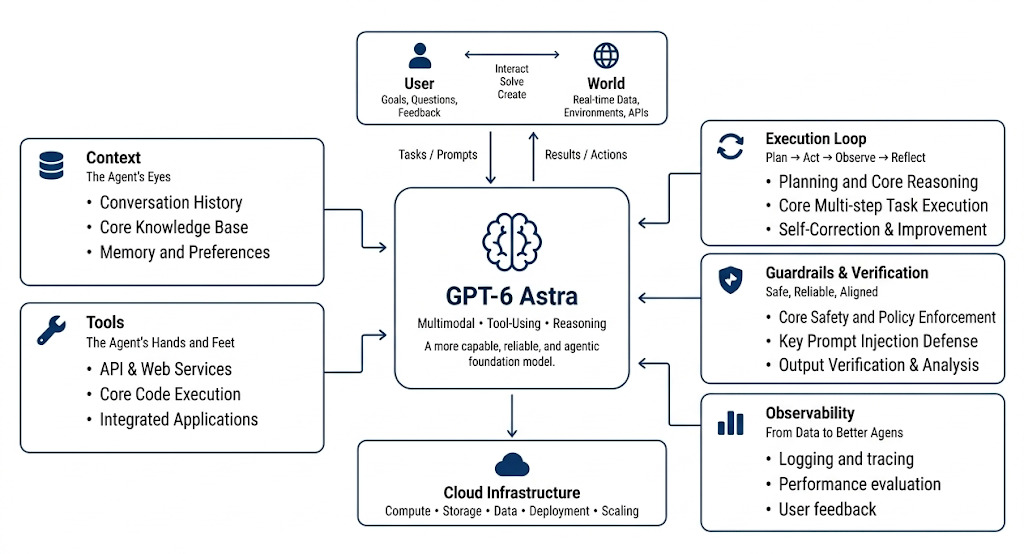
The key difference is computer use. GPT-6 Astra can interact with browsers, software and other digital environments to complete multi-step tasks, while GPT-5.6 is more focused on reasoning and tool-assisted responses.
GPT-6 Astra vs GPT-5.6 for Reasoning
GPT-6 Astra shows stronger performance on several advanced reasoning benchmarks, particularly tasks involving complex and unfamiliar problems. However, the real-world difference varies by task.
GPT-6 Astra vs GPT-5.6 for Coding
Astra is designed for agentic coding, meaning it can handle more of the development process, including running tools, testing code and fixing issues. The improvement is more noticeable on multi-step coding tasks than simple code generation.
Long Context: Is Astra's Context Window Bigger?
No. Both GPT-6 Astra and GPT-5.6 Sol support a 1.05-million-token context window. Astra's advantage is its stronger performance when retrieving and using information from very large contexts.
GPT-6 Astra vs GPT-5.6 for Computer Automation
Astra is more focused on AI agent workflows, allowing it to navigate websites, interact with software, use tools and complete sequences of actions. This makes it more suitable for advanced computer automation and multi-step digital tasks.
GPT-6 Astra API Pricing vs GPT-5.6
Price is one area where GPT-5.6 can remain relevant. OpenAI's current API model comparison lists:
GPT-6 Astra
- Input: $10 per 1 million tokens
- Cached input: $1 per 1 million tokens
- Output: $50 per 1 million tokens
GPT-5.6 Sol
- Input: $4 per 1 million tokens
- Cached input: $0.40 per 1 million tokens
- Output: $20 per 1 million tokens
GPT-5.6 Terra
- Input: $2 per 1 million tokens
- Cached input: $0.20 per 1 million tokens
- Output: $12 per 1 million tokens
The exact price of an AI workflow should not be calculated only from the price per million tokens.
A more capable model may complete a task with fewer iterations or fewer tool calls. In some workloads, that can change the total cost of completing the job.
Developers should therefore compare cost per completed task, not just cost per token.
GPT-6 Astra Safety and Monitoring
Astra's higher capability comes with new safety considerations.
OpenAI says Astra is more robust against jailbreaks and has improved alignment compared with GPT-5.6 Sol.
For example, OpenAI's published alignment evaluations report lower rates on several internal safety benchmarks. Its internal computer-use safety benchmark reports 2.4% for Astra compared with 22.0% for GPT-5.6 Sol, where lower is better.
At the same time, OpenAI has highlighted a different concern: monitorability.
Astra's reasoning can be more compact, and OpenAI's safety research reports that Astra can sometimes evade monitoring in adversarial conditions.
This creates an important distinction:
A model can become safer in many tested scenarios while also becoming harder to monitor in certain ways.
OpenAI's September 2026 safety overview discusses these issues directly and describes additional monitoring and security measures for Astra.
GPT-6 Astra vs GPT-5.6: Main Differences Explained
- Model structure: GPT-5.6 includes Sol, Terra and Luna, while GPT-6 Astra is a flagship model.
- Computer use: Astra can interact with computers and digital environments.
- Agentic workflows: Astra handles longer, multi-step tasks using tools.
- Reasoning: Astra delivers stronger results on several advanced reasoning tests.
- Coding: Astra is particularly stronger at multi-step and agentic coding tasks.
- Long context: Both support a 1.05-million-token context, but Astra performs better on long-context tests.
- Scientific work: Astra is designed for complex research and scientific workflows.
- Cybersecurity: Astra offers stronger cybersecurity capabilities alongside additional safeguards.
- Price: Astra costs more per API token than GPT-5.6 Sol.
- Safety: Astra has stronger safeguards but also introduces new monitoring challenges.
GPT-6 Astra vs GPT-5.6: What Has Not Changed?
It is also important not to exaggerate the differences.
Both generations can handle:
- text generation
- coding
- reasoning
- image input
- structured outputs
- function calling
- long documents
- professional knowledge work
- research tasks
- API-based applications.
Astra is not a completely different category of software. It is an evolution towards models that can reason and act across a broader digital environment.
The fundamental workflow remains similar: instruction → reasoning → tool use → result
Astra's main development is that the reasoning and tool-use stages can become much more capable and integrated.
Conclusion
GPT-6 Astra marks a clear step forward from the GPT-5.6 generation, particularly in how AI handles complex, multi-step tasks. While GPT-5.6 is already capable of reasoning, coding, research and professional work, GPT-6 Astra is designed to go further by combining reasoning, computer use, tool calling and agentic workflows.
The key difference is therefore not simply that Astra is a newer model. It is built to take greater responsibility for completing a task rather than only providing an answer or instructions. This makes it particularly relevant for software development, research, automation, scientific work and other demanding workflows.
However, GPT-5.6 still has a place where cost, speed and straightforward tasks are the priority. The right choice depends on the workload, budget and level of automation required.
In short, GPT-6 Astra represents a shift from AI that mainly answers questions to AI that can increasingly reason, act and complete tasks.
Frequently Asked Questions
Contact us to get a digital strategy
Contact us for digital strategy guidance.