
Getting website traffic is only the first step. The real challenge is turning visitors into customers who take action, whether that means making a purchase, booking a service, requesting a quote, or contacting your business.
To increase conversions, businesses need to understand visitor behaviour, improve website experience, build trust, create clear journeys, and remove barriers that stop people from buying.
This guide explains how to turn website visitors into customers using practical methods, including website conversion optimisation, user experience improvements, content strategies, personalisation, trust-building techniques, and data-driven decisions.
Why Website Visitors Do Not Always Become Customers
Many businesses invest time and money into driving visitors to their websites but struggle to convert those visitors into paying customers.
A website may receive thousands of visitors every month, but if users cannot quickly understand your offer, trust your business, or find the next step, they will leave without taking action.
The goal of modern website optimisation is not just to increase traffic. It is to create a website experience that helps visitors move from awareness to consideration and finally to purchase.
Understanding how to turn website visitors into customers requires looking at the complete customer journey:
- Why did the visitor come to your website?
- What problem are they trying to solve?
- What information do they need before buying?
- What could stop them from taking action?
- How can your website make the decision easier?
A successful website answers these questions clearly.
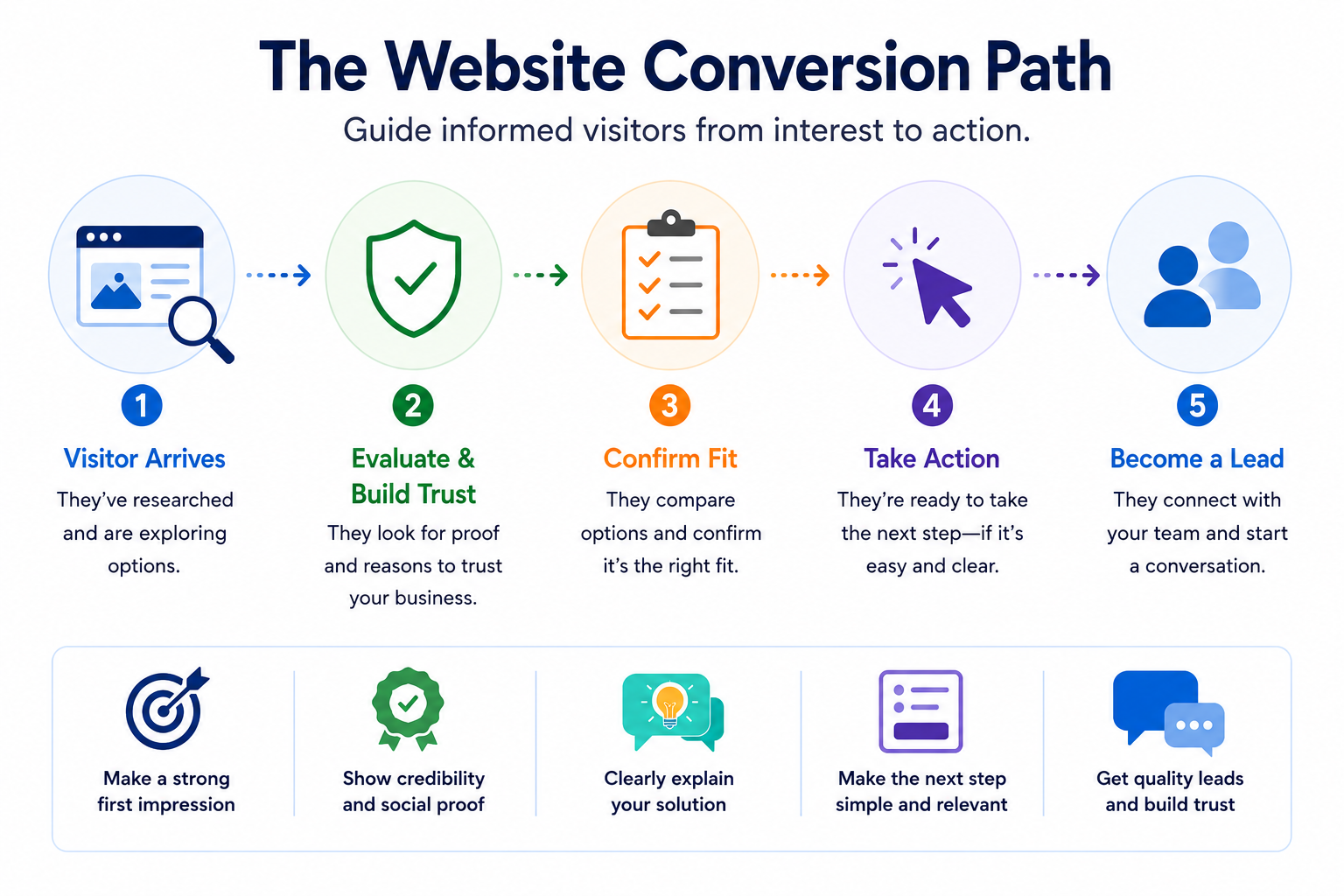
Understanding the Customer Journey Before Optimising Your Website
Before applying website conversion strategies, businesses need to understand how customers make decisions. Most visitors follow a journey similar to this:
1. Awareness Stage
Visitors discover your business and look for helpful information to solve their problems.
They may search for:
- Solutions to a problem
- Product information
- Service comparisons
- Industry advice
Your website should provide helpful content that answers their questions.
2. Consideration Stage
Visitors compare your business with competitors and look for proof that you are the right choice.
They want to know:
- Why should they choose your business?
- What makes your service different?
- Do other customers trust you?
- Is your solution worth the investment?
This is where case studies, reviews, demonstrations, and detailed service pages become important.
3. Decision Stage
Visitors are ready to take action, so make it easy to contact you, book a service, or make a purchase.
Your website should make it simple to:
- Contact you
- Purchase
- Book a consultation
- Complete checkout
A confusing process at this stage can lose potential customers.
 12 Effective Ways to Turn Website Visitors into Customers
Discover 12 proven website conversion strategies that help improve user experience, build trust, and turn more website visitors into paying customers.
1. Create a Clear Website Value Proposition
Clearly explain what your business offers, who it helps, and why customers should choose you within the first few seconds of visiting your website. Visitors decide within seconds whether a website is relevant to them.
Your homepage should clearly explain:
- What your business offers
- Who you help
- What problem you solve
- Why customers should choose you
Avoid complicated wording. A clear message helps visitors immediately understand whether your business can meet their needs.
Example:
Instead of: “Providing innovative digital solutions through advanced technology systems.”
Use: “We help businesses build fast, user-friendly websites that attract customers and increase enquiries.”
Clarity improves trust and engagement.
2. Improve Website User Experience (UX)
User experience plays a major role in conversions. A visitor is more likely to become a customer when your website is:
- Easy to navigate
- Fast to load
- Mobile-friendly
- Simple to understand
- Accessible
Important UX improvements include:
Simple Navigation: Visitors should find important pages easily.
- Services
- Products
- Pricing
- Contact information
- Customer reviews
Faster Loading Speed: Slow websites create frustration.
Users expect websites to load quickly, especially on mobile devices. A delay of even a few seconds can increase abandonment rates.
Mobile Optimisation: Most online searches happen on mobile devices. A website that does not work properly on smartphones can lose potential customers.
3. Use Strong and Relevant Calls to Action (CTAs)
Guide visitors towards the next step with clear, action-focused CTAs that explain exactly what will happen when they click.
Examples include:
- Get a Free Quote
- Book a Consultation
- Start Your Project
- Request More Information
- Buy Now
A good CTA should be:
- Clear
- Visible
- Relevant to the visitor’s stage
- Easy to complete
Avoid using unclear buttons like:
- Submit
- Click Here
- Continue
Visitors should know exactly what will happen after clicking.
4. Build Trust with Social Proof
People are more likely to buy from businesses they trust. Trust signals help reduce uncertainty.
Customer Reviews: Reviews show real experiences from existing customers.
Case Studies: Case studies explain:
- The customer problem
- Your solution
- The results achieved
Testimonials: Short customer statements can increase confidence.
Business Information:
- Contact details
- Company background
- Industry experience
- Certifications where relevant
Trust is a major factor in converting visitors into customers.
5. Create Helpful and Customer-Focused Content
Content should answer customer questions instead of only promoting your business.
High-quality content can include:
- Blog articles
- Guides
- FAQs
- Comparison pages
- Product explanations
- Videos
For example, someone searching “how to choose a website design company” may not be ready to buy immediately.
A helpful article can introduce your brand and guide them towards becoming a customer later. This approach supports both SEO and conversions.
6. Improve Landing Pages
Design focused landing pages with clear benefits, trust signals, and strong calls to action that encourage visitors to convert.
A high-converting landing page should include:
- A focused headline
- Clear benefits
- Supporting information
- Trust elements
- Customer proof
- Strong CTA
Avoid adding too many distractions.
The visitor should understand:
- What the offer is
- Why it Important
- What action to take
7. Use Data to Understand Visitor Behaviour
Successful website conversion optimisation depends on understanding how users interact with your website.
Useful data includes:
- Which pages receive the most traffic
- Where visitors leave
- Which buttons receive clicks
- How users move through the website
- Which pages generate enquiries
Tools such as analytics platforms, heatmaps, and customer feedback systems help identify improvement opportunities.
Data allows businesses to make decisions based on user behaviour rather than assumptions.
8. Personalise the Website Experience
Deliver relevant content, recommendations, and offers based on visitor interests to create a more engaging and personalised experience.
Personalisation can include:
- Showing relevant content based on visitor interests
- Recommending suitable products
- Displaying location-specific information
- Providing targeted offers
However, personalisation should improve the customer experience without making visitors feel uncomfortable.
Good personalisation helps users find what they need faster.
9. Reduce Customer Friction
Remove unnecessary obstacles by simplifying forms, improving navigation, and making it easy for visitors to complete their journey. Many visitors leave because the buying process feels difficult.
Common problems include:
- Too many form fields
- Unclear pricing
- Complicated checkout
- Slow responses
- Missing information
To improve conversions:
- Simplify forms
- Provide clear answers
- Add FAQs
- Make contact options easy
- Explain next steps
Removing friction makes purchasing easier.
10. Use Email Marketing to Convert Returning Visitors
Not every visitor is ready to buy immediately. Email marketing helps businesses stay connected with potential customers.
Useful email campaigns include:
- Welcome emails
- Helpful guides
- Product updates
- Special offers
- Follow-up messages
A visitor who leaves today may become a customer later with the right information.
11. Improve Website Security and Trust
Visitors need confidence before sharing personal details or making payments.
Important trust factors include:
- Secure website connections
- Clear privacy policies
- Transparent business information
- Secure payment options
A professional and secure website creates confidence.
12. Test and Improve Regularly
Continuously test and refine your website's content, design, and conversion elements to improve performance and increase customer conversions.
Businesses should regularly test:
- Headlines
- Page layouts
- CTA wording
- Images
- Forms
- Content structure
Small improvements can create significant results over time.
Website Conversion Strategies That Work in 2026
As online competition increases, businesses need smarter approaches. Some important website conversion strategies for 2026 include:
1. AI-Assisted Customer Experiences
Artificial intelligence is helping websites provide faster support through:
- Smart search
- Automated assistance
- Personalised recommendations
- Faster customer responses
2. Better First-Hand Customer Experience
Search engines increasingly value websites that demonstrate real expertise and useful information.
Businesses should focus on:
- Original content
- Real examples
- Customer experiences
- Expert advice
3. Voice and Conversational Search Optimisation
People increasingly search using natural questions. Websites should include content that answers conversational queries such as:
- “Which service is best for my business?”
- “How can I improve my website sales?”
Experience-Based SEO: Modern SEO is not only about keywords.
Search engines consider:
- Content usefulness
- Website quality
- User satisfaction
- Expertise
- Trust signals
Common Mistakes That Stop Visitors Becoming Customers
- Focusing Only on Traffic: More visitors do not automatically mean more sales. Quality traffic matters more than quantity.
- Poor Website Design: A confusing website can damage credibility.
- Weak Content: Visitors need answers before making decisions.
- Missing Trust Elements: Without reviews, examples, or clear information, users may choose competitors.
- Difficult Contact Process: If customers struggle to contact you, they may leave.
How to Track Website Conversion Success
Important conversion metrics include:
- Conversion Rate: Shows the percentage of visitors completing desired actions.
- Bounce Rate: Shows how many visitors leave without interaction.
- Average Time on Page: Indicates whether visitors find content useful.
- Customer Acquisition Cost: Shows how much it costs to gain a customer.
- Lead Quality: Measures whether enquiries are likely to become customers. Tracking these metrics helps businesses improve their website performance.
Conclusion
Getting visitors to your website is only the beginning. The real growth comes from creating an experience that helps people understand your offer, trust your business, and take action.
The best approach to how to turn website visitors into customers is a combination of:
- Clear messaging
- Strong user experience
- Helpful content
- Trust signals
- Data-driven improvements
- Effective website conversion strategies
Website conversion optimisation is not a one-time activity. It requires continuous improvement based on customer behaviour and changing expectations.
If you want to improve your website performance and create a customer-focused digital experience, WOWinfotech can help you build, optimise, and improve your website to generate more enquiries and business growth. Contact WOWinfotech today to discuss your website conversion goals.
Frequently Asked Questions
Contact us to get a digital strategy
Contact us for digital strategy guidance.