Optimising landing pages for SEO and conversions means creating pages that rank in search engines while encouraging users to take action. This involves aligning search intent, target keywords, user experience (UX), and conversion rate optimisation (CRO) with a clear value proposition and strong call-to-action (CTA).
From a semantic SEO perspective, search engines prioritise context, relevance, and structured content, so your page should naturally include related elements like Core Web Vitals, A/B testing, and high-converting design practices.
What is Landing Page Optimisation?
Landing page optimisation (LPO) is the process of improving elements on a page to increase conversions such as enquiries, sign-ups, or purchases.
Unlike a homepage, a landing page is designed with one specific goal, making it essential for both:
- SEO (Search Engine Optimisation)
- CRO (Conversion Rate Optimisation)
Why SEO & Conversions Must Work Together
Treating SEO and CRO separately limits performance.
- SEO drives traffic
- CRO drives results
When combined effectively:
- You attract high-intent users
- Reduce bounce rates
- Increase ROI
In modern search (including AI-driven results), Google prioritises intent-matching, high-performing pages.
How to Optimise Landing Pages
Here’s a simple guide on how to optimise landing pages.
1. Start with Search Intent
Before anything else, define:
- What is the user looking for?
- Are they ready to convert?
Intent Types:
- Transactional (buy now)
- Commercial (compare options)
- Lead generation (enquire/sign up)
If intent doesn’t match, rankings and conversions will suffer.
2. Keyword Strategy
Use a structured keyword approach to improve both search visibility and conversion intent. Focus on one primary keyword while supporting it with semantically related and long-tail phrases.
Use:
- 1 primary keyword
- Multiple related (LSI) terms
- Long-tail, high-intent phrases
Example:
- Primary: optimise landing pages for SEO & conversions
- Related:
- landing page SEO checklist
- conversion rate optimisation tips
- high-converting landing pages
3. Optimise On-Page SEO Elements
Ensure your core on-page elements are fully optimised to improve both rankings and click-through rates.
Ensure:
- Title tag (clear + benefit-driven)
- Meta description (improves CTR)
- H1 headline (aligned with intent)
- Clean URL structure
These elements improve both visibility and click-through rate.
4. Create a High-Converting Headline
Your headline is the first thing users see make it count.
Your headline should:
- Address a problem
- Offer a clear benefit
- Be easy to understand
Example:
“Digital Marketing Platform”
“Boost Conversions with High-Performance Landing Pages”
Clarity always outperforms clever wording.
5. Focus on a Single CTA
A landing page should guide users towards one clear action.
A landing page should have:
- One objective
- One call-to-action
Too many choices lead to:
- Confusion
- Lower conversion rates
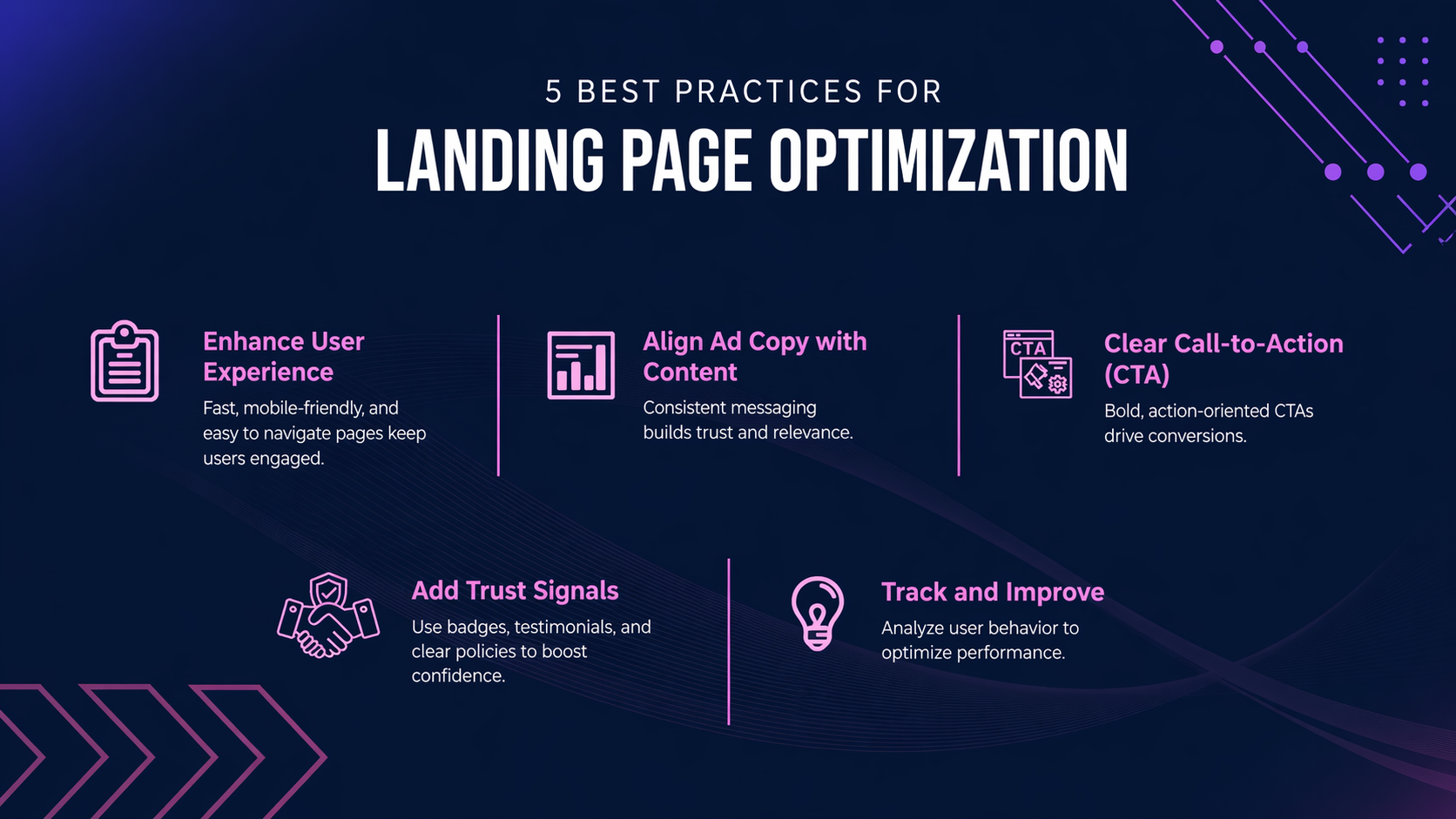
6. Improve UX & Page Design
User experience plays a major role in both SEO and conversions.
Best Practices:
- Clean layout
- Clear visual hierarchy
- Mobile-first design
- Minimal distractions
Good design guides users towards action.
7. Write Scannable, Persuasive Content
Users typically scan rather than read every word.
Structure your content with:
- Short paragraphs
- Bullet points
- Clear headings
This improves both engagement and SEO performance.
8. Add Trust Signals
Trust is a key factor in conversion decisions.
Build credibility with:
- Testimonials
- Reviews
- Case studies
- Certifications
- Client logos
Trust directly impacts conversion rates.
9. Improve Page Speed & Core Web Vitals
A slow website reduces conversions and rankings.
Focus on:
- Fast loading times
- Mobile optimisation
- Image compression
Aim for load times under 3 seconds.
10. Use A/B Testing
Continuous testing is essential for optimisation.
Continuously test:
- Headlines
- CTA buttons
- Layout
- Forms
Optimisation is ongoing not a one-time task.
Advanced Strategies (2026 Trends)
Here are effective strategies for optimising landing pages.
AI & AEO (Answer Engine Optimisation)
- Optimise for AI-generated answers
- Add FAQ schema
- Provide concise, direct responses
Behavioural Data Optimisation
Use tools such as:
- Heatmaps
- Session recordings
- Analytics platforms
Understand how users actually interact with your page.
Internal Linking
- Link to supporting pages
- Build topical authority
Helps both SEO and navigation.
Landing Page Optimisation Checklist
Here’s a checklist for landing page optimisation.
- Match search intent -Align content with what users are searching for
- Use semantic keywords -Include related and long-tail keywords
- Optimise metadata -Improve title tags and meta descriptions for better CTR
- Clear value proposition -Clearly communicate your offer and benefits
- Single CTA -Focus on one clear call-to-action
- Mobile-first design -Ensure responsiveness across all devices
- Fast load speed -Keep page loading under 3 seconds
- Trust signals -Add reviews, testimonials, and credibility elements
- Regular testing -Continuously improve using A/B testing
Conclusion
Optimising landing pages for SEO and conversions helps businesses attract the right audience, improve visibility, and turn visitors into leads or customers. By combining search intent, semantic SEO, user experience (UX), and conversion rate optimisation (CRO), you create pages that not only rank but also perform.
Focus on the right strategy. Use clear messaging, strong CTAs, and optimise for speed and mobile experience. Continuously test and refine your pages to improve results over time.
With consistent effort and smart optimisation, landing pages can become one of your most powerful growth tools.
If you’re looking to optimise landing pages for SEO and conversions, connect with WOWinfotech to build high-performing pages that drive real business results.
FAQs
Contact us to get a digital strategy
Contact us for digital strategy guidance.