
If your customers know your name but barely recognise your company, are you building a personal brand or a business brand? That question is more important than ever for founders, consultants and growing businesses.
Choosing between personal branding vs business branding is not simply about whether you should post on LinkedIn or create a stronger company identity. It is about deciding what you want people to trust, remember and choose you or the organisation you are building.
A personal brand can make your expertise, experience and reputation the reason people choose you. A business brand can build an identity that continues to grow, attract customers and operate even when you are not involved.
So, which should you focus on first? The answer depends on your business model, your customers and where you want the business to be in the future.
Personal Branding vs Business Branding: The Real Difference
The simplest difference is this: personal branding builds trust around you, while business branding builds trust around your company.
A personal brand focuses on your name, expertise, experience, personality and reputation. It works well when customers choose you because of your knowledge or professional reputation.
A business brand focuses on the company, its products or services, values, customer experience and reputation. It is more suitable when you want the business to grow beyond you.
Neither is automatically better. The right choice depends on what you sell, why customers choose you and whether you want the business to depend on you long term.
Quick rule: If people are buying you, focus on personal branding. If they are buying the company, focus on business branding. If you want both, build a personal brand for authority and a business brand for long-term growth.
What is Personal Branding?
Personal branding is building a professional reputation around you. It includes your expertise, experience, opinions, values, content and achievements.
It is not just about social media. A strong personal brand helps people recognise what you know, what you do and why they should trust you.
Example: A consultant known for solving a specific business problem is building a personal brand.
What is Business Branding?
Business branding is building recognition and trust around a company. It includes the company name, positioning, visual identity, products, services, messaging, customer experience and reputation.
The main goal is to create a brand that can grow beyond the founder.
In simple words: personal branding makes people remember you; business branding makes people remember your company.
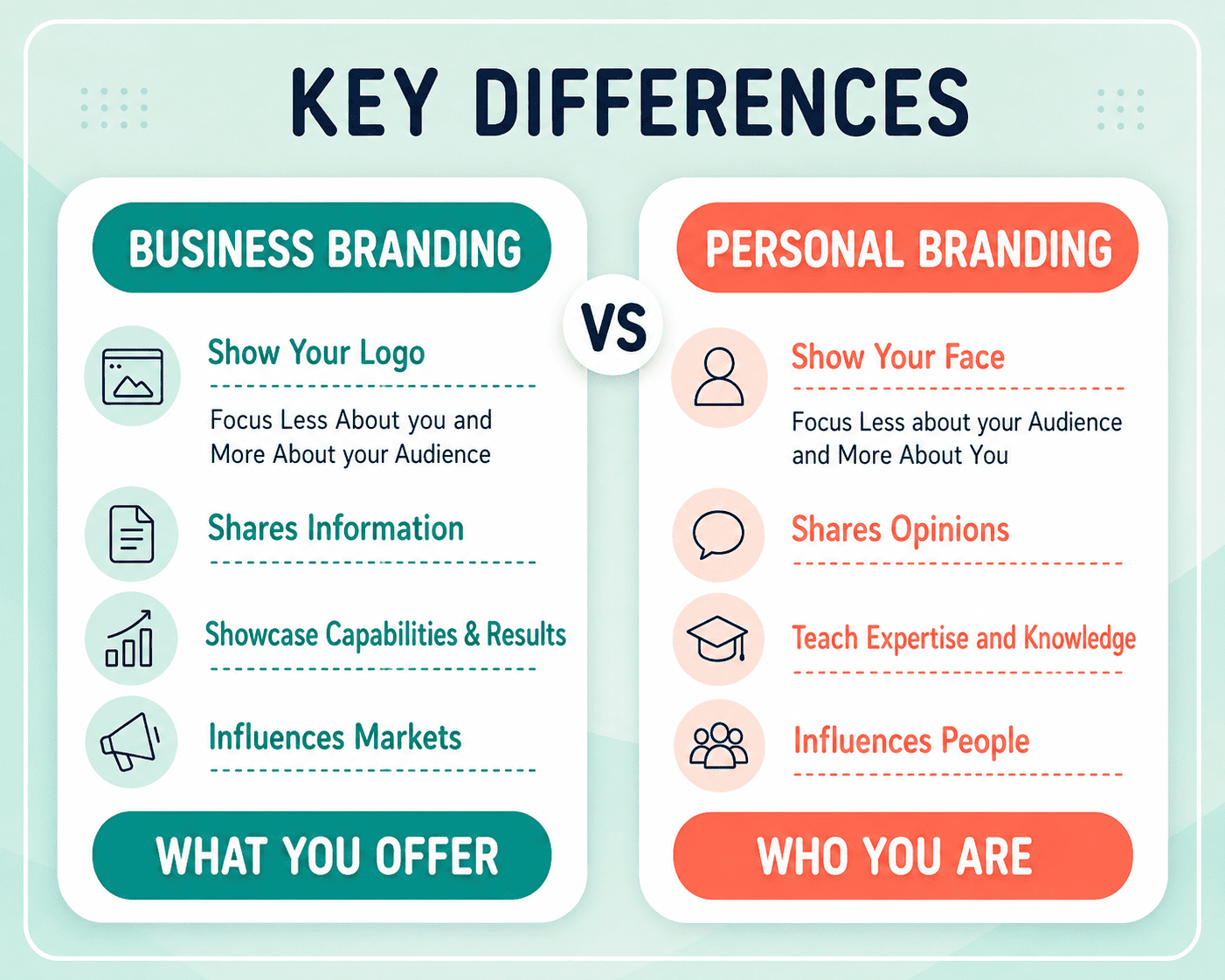
Personal Brand vs Business Brand: Differences
A quick comparison of personal and business branding, including their key differences, strengths and best use cases.
|
Personal branding |
Business branding |
|
Centres on an individual |
Centres on a company |
|
Reputation is closely linked to the person |
Reputation is linked to the organisation |
|
Expertise can be the main attraction |
Products, services and customer experience are central |
|
Often works well for experts and service providers |
Often works well for scalable companies |
|
Usually easier to start as a solo professional |
Usually requires a clearer organisational identity |
|
Can create strong personal trust |
Can create trust in the organisation |
|
Audience often follows the individual |
Audience often follows the company |
|
Can be difficult to separate from the founder |
Can operate without the founder being visible |
|
Strong for thought leadership |
Strong for scalability and continuity |
|
Can move with the individual |
Can become a business asset |
The distinction is not absolute.
A company can have a strong business brand while its founder has a strong personal brand at the same time. In fact, that is often the most useful structure for an established founder.
Personal Branding: Advantages and Disadvantages
Personal branding can build trust and recognition around your expertise, but it can also create founder dependency.
Advantages
- Shows expertise -Highlights your knowledge, skills, and experience.
- Builds trust -Makes customers feel confident in you.
- Creates authority -Establishes you as an industry expert.
- Helps networking -Builds valuable professional connections and relationships.
- Creates opportunities -Opens doors to partnerships and consulting.
Disadvantages of Personal Branding
- Creates founder dependency -Business growth may depend heavily on you.
- Can make selling harder -Businesses may be harder to transfer.
- Increases reputation risk -Personal mistakes can harm the business.
- Requires ongoing involvement -Needs regular content and public visibility.
- Can limit scalability -Growth may depend on your availability.
Business Branding: Advantages and Disadvantages
Business branding builds company recognition and supports independent growth.
Advantages
- Builds an independent business asset -Business grows beyond the founder.
- Supports scalability -Helps teams and products grow consistently.
- Creates consistency -Maintains consistent messaging and customer experience.
- Reduces founder dependency -Customers connect with the company directly.
- Works well for products and services -Suitable for growing businesses and organisations.
Disadvantages
- Can feel less personal -May take longer to build trust.
- Can take time to establish -Reputation grows through consistent customer experiences.
- Can hide expertise -Customers may not see company expertise.
- Can focus too much on visuals -Branding involves more than logos and colours.
So, Which Should You Focus On First?
The right choice depends on why customers choose your business.
Ask yourself:
“Would customers still choose my business if I were not personally involved?”
- If no: Focus more on personal branding because your expertise, reputation and relationships are driving the buying decision.
- If yes: Give more attention to business branding so the company can build its own identity and reputation.
Also consider your long-term goal:
Do you want to be known for your expertise, or do you want to build a business that can operate and grow without you?
If customers are buying you, start with personal branding. If they are buying your company, prioritise business branding. If you want both, build them together with clear roles.
Choose Personal Branding First If…
Choose personal branding when your expertise, experience and reputation are the main reasons customers choose you.
It works well for:
- Consultants
- Freelancers
- Coaches
- Speakers
- Creators
- Authors
- Advisers
- Professional service providers
- Industry experts
Example: If you are an independent consultant, clients are likely to care about your experience, knowledge and track record. In this case, your personal reputation can be more important than a company name.
Choose Business Branding First If…
Choose business branding when you want to build a company that can grow beyond you.
It works well for:
- Software companies
- E-commerce businesses
- Product companies
- Larger agencies
- Manufacturers
- Subscription businesses
- Technology companies
- Franchises
Example: If you are building a software company with a team and many customers, the focus should be on building trust in the company and its product, not only the founder.
Simple rule: Build a personal brand when people buy your expertise; build a business brand when people buy the company.
Personal Branding vs Business Branding for Different Business Types
The right branding approach depends on your business model, customers and long-term goals.
1. Freelancers
Personal branding usually comes first. Clients are hiring your skills, experience and expertise directly, so your name and reputation matter.
2. Consultants
Personal branding is often the priority. Clients need to trust your knowledge, experience and ability to solve specific problems.
3. Coaches
Personal branding is central. Your personality, approach, experience and reputation are often a key part of the service.
4. Creators
Personal branding usually leads. Audiences typically follow the individual, their ideas and content rather than a separate company.
5. Professional Services
A combination works well. Lawyers, accountants and advisers can build personal credibility while developing a trusted firm.
6. Agencies
A hybrid approach is often best. The founder can build authority while the agency develops its own reputation, team and client relationships.
7. SaaS Companies
Business branding should usually lead. Founder visibility can build awareness, but customers ultimately need to trust the software, company and support.
8. E-commerce
Business branding normally comes first. Product quality, customer experience and company reputation are usually more important than the founder.
9. Consumer Products
Business branding is usually the priority. Customers need to recognise and trust the product and company, rather than depend on the person behind it.
How to Build a Personal Brand Without Becoming an Influencer
You do not need thousands of followers to build a strong personal brand. Start by making your expertise, experience and professional reputation clear.
1. Define Your Expertise
Identify the problems you solve and the knowledge you can genuinely share.
2. Know Your Audience
Be specific about who you help and what they need.
3. Share Your Point of View
Talk about what you have learnt, what works, common mistakes and changes in your industry.
4. Publish Useful Content
Create articles, guides, case studies and practical answers based on your real experience.
5. Show Evidence
Use relevant qualifications, projects, client results, publications, testimonials and professional experience.
6. Stay Consistent
You do not need to post every day. Focus on being useful, credible and recognisable over time.
How to Build a Business Brand
A business brand should make the company clear, recognisable and trustworthy.
1. Define Your Purpose: Explain the problem your business solves.
2. Know Your Customers: Understand your customers and their expectations.
3. Clarify Your Positioning: Show what you offer and why it matters.
4. Create a Consistent Identity: Use consistent branding, messaging, and tone.
5. Deliver Consistent Customer Experience: Ensure service matches your brand promise.
6. Build Trust: Use reviews, testimonials, expertise, and results.
7. Reduce Founder Dependency: Build systems and teams beyond one person.
What Happens When a Personal Brand Becomes Too Strong?
A personal brand can become a problem when the business depends entirely on its founder.
Common signs include:
- Customers only want to speak to the founder
- The founder handles most sales
- Marketing stops when the founder stops posting
- Employees depend on the founder for decisions
- Customers do not recognise the wider team
- The company has little recognition without the founder
- The founder's reputation is stronger than the company brand
When this happens, strengthening the business brand, team and systems can reduce founder dependency.
Can You Move From Personal Branding to Business Branding?
Yes. Many businesses start with the founder's name and gradually develop a separate company identity.
A typical progression is:
Stage 1: Your name → Your service
Stage 2: Your name → Your service + team
Stage 3: Your name → Expertise and leadership
Stage 4: Company brand → Team + systems + services
Your personal brand does not have to disappear. Its role simply changes from being the business to supporting the business.
Personal Branding vs Business Branding: A Simple Decision Framework
Choose Personal Branding If:
- Customers buy your expertise
- Your reputation drives enquiries
- You work as a consultant, freelancer or independent professional
- Your name is closely connected to your service
- You want to build professional authority
Choose Business Branding If:
- You sell products or software
- You are building a team
- You want the company to operate without you
- You plan to scale or sell the business
- Customers primarily choose the company or product
Choose Both If:
- You are a founder-led business
- Your expertise helps attract customers
- You want personal visibility without founder dependency
- You want to build long-term company value
Personal Branding in 2026: What Has Changed?
AI has made it easier to produce large amounts of generic content. As a result, real experience, original knowledge and a clear point of view are increasingly important.
Personal branding also extends beyond social media. Your reputation can appear across search results, professional networks, websites, publications, podcasts and online communities.
A strong personal brand in 2026 should be:
- Authentic
- Accurate
- Consistent
- Evidence-based
- Useful
- Easy to understand
- Based on real experience
The focus should not be on publishing everywhere. Build a credible reputation by sharing knowledge you genuinely understand and can support with real experience.
Conclusion
Personal branding works best when customers trust your expertise and reputation, while business branding is better when you want to build a company that can grow independently of you. For many founders, combining both offers the best balance.
The key is to build a clear, consistent brand that matches your business goals.
Ready to strengthen your brand? WOWinfotech can help with your website, content and digital branding strategy. Get in touch today to discuss your goals.
FAQs
Personal branding is usually stronger when an individual's expertise and reputation drive the buying decision. Business branding is usually stronger when the organisation, product, service or customer experience needs to stand independently.
A business brand, on the other hand, can form part of a company and can therefore be transferred as part of an acquisition or sale.
Recognition develops through repeated exposure, useful work, relationships and evidence of expertise. A professional may become known within a niche relatively quickly, while a broader reputation can take years.
If a future buyer is acquiring a company, it is helpful for the company to have customers, systems, intellectual property and reputation that are not entirely dependent on the founder.
Contact us to get a digital strategy
Contact us for digital strategy guidance.