
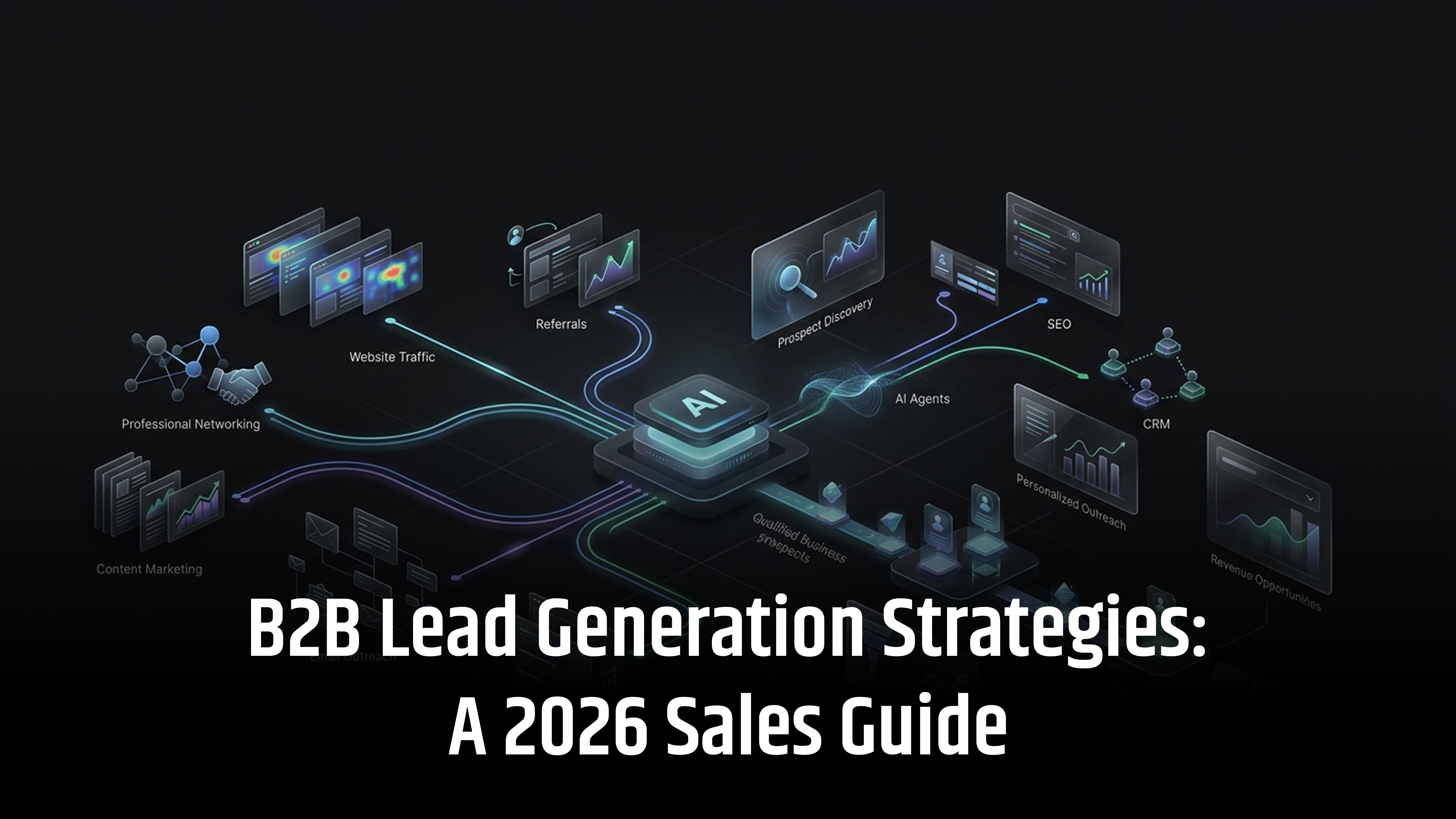
Generating more B2B leads does not always mean generating more sales. In 2026, buyers can research your company, compare competitors, read reviews and use AI tools to evaluate solutions before they ever speak to your sales team. This has made B2B lead generation more competitive and simply sending more emails, publishing more content or buying more contact lists is no longer enough.
A successful B2B lead generation strategy starts with reaching the right companies, understanding their buying journey and giving them useful reasons to trust your business. From SEO and LinkedIn to account-based marketing, intent data, email outreach, AI, lead scoring and CRM automation, businesses now have more ways to find and engage potential customers. But the real challenge is knowing which channels to use, when to use them and how to turn interest into qualified opportunities.
This guide explains the most effective B2B lead generation strategies for 2026, how they work, what to measure and how to build a lead generation system that supports sustainable sales growth.
15 B2B Lead Generation Strategies for 2026
B2B lead generation in 2026 is not about using every available channel. It is about choosing the channels that match your target market, buying journey, sales cycle and deal value. A strong strategy combines organic and paid acquisition, sales outreach, customer data, intent signals and useful content to attract and convert the right business prospects.
1. Define Your Ideal Customer Profile (ICP)
Before generating leads, define exactly which companies you want to win. Your ICP should cover industry, company size, location, revenue, technology, business needs, buying process and likely contract value.
Then identify the people involved in the purchase, such as the economic buyer, decision-maker, technical stakeholder and end user. This prevents your sales team from spending time on contacts who are unlikely to become customers.
Takeaway: Start with the right accounts, not a large contact list.
2. Build a Search-Led B2B Content Strategy
Create content around the problems, questions and buying decisions your potential customers search for. Cover the full journey, from informational topics to commercial searches, comparisons and pricing-related questions.
For example, instead of publishing generic cybersecurity content, build a topic cluster around cybersecurity risk assessment, MDR, SOC services, compliance, pricing and provider comparisons.
Takeaway: Create content that answers real buyer questions and supports commercial intent.
3. Optimise for Search and AI Discovery
B2B buyers increasingly use Google and AI tools such as ChatGPT and Gemini to research products and suppliers. Your content should therefore be clear, well-structured and comprehensive enough to answer questions directly.
Use semantic SEO by naturally covering related entities and concepts such as lead scoring, CRM, buyer personas, intent data, sales pipeline, ABM, demand generation and conversion.
Takeaway: Optimise for understanding and usefulness, not keyword repetition.
4. Use LinkedIn for B2B Prospecting
LinkedIn is particularly useful for reaching decision-makers by job title, industry, company and seniority. Use it for expert content, employee-led posts, targeted advertising, account research and direct sales outreach.
Focus on useful content such as industry insights, original research, customer lessons, buying guides and practical advice rather than constant promotional posts.
Takeaway: Use LinkedIn to build visibility, credibility and relevant conversations.
5. Use Account-Based Marketing (ABM)
Account-based marketing focuses sales and marketing resources on a defined list of high-value companies instead of treating every lead equally.
Identify target accounts, map their buying groups, understand their business priorities and create relevant outreach for each account. ABM works particularly well for enterprise sales, high-value contracts and long sales cycles.
Takeaway: For high-value B2B sales, target accounts rather than chasing large volumes of contacts.
6. Use Intent Data and Buying Signals
A job title tells you who someone is; a buying signal can indicate what is happening now.
Useful signals include:
- New executives
- Company funding
- Rapid hiring
- Acquisitions
- Technology changes
- Expansion
- New regulations
- Product launches
- Pricing-page visits
- Relevant content engagement
The important part is identifying signals that actually correlate with sales opportunities in your market.
Takeaway: Contact prospects because there is a relevant reason to talk, not simply because they match a job title.
7. Improve B2B Data Quality
Lead generation depends on accurate data. Outdated job titles, duplicate records, incorrect email addresses and incomplete company information can reduce both sales productivity and campaign performance.
Maintain useful firmographic, technographic, contact, behavioural and intent data in your CRM and review it regularly.
Takeaway: Better data leads to better targeting, better outreach and more reliable reporting.
8. Use Lead Scoring to Prioritise Prospects
Not every lead deserves the same level of sales attention. Lead scoring helps rank prospects according to their fit and behaviour.
Consider factors such as:
- Company fit
- Job role
- Industry
- Website activity
- Content engagement
- Pricing-page visits
- Demo requests
- Buying signals
Your scoring model should be based on what your actual customers and successful opportunities have done, rather than arbitrary scores.
Takeaway: Prioritise prospects based on both fit and buying behaviour.
9. Use Email for Nurturing and Prospecting
Email can support both lead nurturing and sales outreach, but the approach should be relevant to the recipient.
For existing leads, provide useful information based on their interests and stage in the buying journey. For outbound sales, research the prospect first and explain why the conversation may be relevant to their business.
Takeaway: Relevant email beats high-volume generic outreach.
10. Combine Inbound and Outbound Lead Generation
Inbound and outbound should work together.
Inbound brings prospects through SEO, content, LinkedIn, referrals, events and other discovery channels.
Outbound allows sales teams to proactively approach suitable accounts through email, phone, LinkedIn and other channels.
A prospect may discover your content, engage with your LinkedIn profile, receive a relevant sales message and later book a meeting.
Takeaway: Build a connected, multi-channel buyer journey instead of relying on one source of leads.
11. Create High-Value Lead Magnets
Give potential buyers a useful reason to engage with your business. Effective B2B lead magnets include:
- Buying guides
- Industry reports
- Research
- Checklists
- Templates
- Calculators
- Assessments
- Comparison guides
- Webinars
The resource should be closely connected to your product or service so that it attracts relevant prospects, not simply more downloads.
Takeaway: A smaller number of relevant leads is more valuable than a large number of unrelated contacts.
12. Use Webinars and Expert-Led Content
For complex B2B products, buyers often need education before they are ready to speak with sales.
Use webinars, expert panels, technical demonstrations, customer interviews, industry briefings and live Q&A sessions to answer difficult questions and build trust.
Follow up based on engagement. Someone who attended and asked questions is more valuable than someone who only registered.
Takeaway: Use expert content to help buyers understand the problem and evaluate the solution.
13. Generate Leads Through Referrals and Customer Advocacy
Your existing customers can become an important source of new B2B opportunities.
Encourage referrals through:
- Customer introductions
- Case studies
- Reviews
- Partner relationships
- Industry communities
- Customer events
- Professional networks
Customer experiences can provide evidence that is difficult to create through advertising alone.
Takeaway: Build a referral process into your customer relationship rather than treating referrals as an occasional bonus.
14. Turn Your Website Into a Sales Resource
Your website should answer the questions buyers have before they contact sales.
Make it easy to find information about:
- Products and services
- Use cases
- Industries served
- Pricing
- Implementation
- Integrations
- Security
- Customer results
- Comparisons
- FAQs
- The company and its experts
A strong B2B website should help prospects understand whether your solution fits their business, what it costs, how it works and why they should trust you.
Takeaway: Your website should help qualify and educate buyers, not just introduce your company.
15. Use AI and Automation Without Losing Human Judgement
AI can help sales and marketing teams with prospect research, lead enrichment, scoring, CRM updates, account research, content creation, meeting summaries and workflow automation.
However, automation should not mean sending thousands of generic messages. Use AI to reduce repetitive work while keeping human judgement in decisions about who to contact, why to contact them and what to say.
Takeaway: Automate repetitive tasks, but keep strategy, relevance and sales conversations human.
B2B lead generation channels: which one should you use?
Choose B2B lead generation channels based on your target audience, sales cycle, deal value and buyer behaviour rather than trying to use every channel available.
|
Channel |
Best suited to |
Main advantage |
Main limitation |
|
SEO |
Problem-aware buyers |
Compounds over time |
Takes time |
|
|
Professional audiences |
Strong targeting and distribution |
Can become expensive or noisy |
|
|
Nurturing and prospecting |
Direct communication |
Data and relevance matter |
|
Cold calling |
High-value sales |
Immediate conversation |
Requires good targeting |
|
ABM |
Enterprise accounts |
Focused resources |
Requires account research |
|
Webinars |
Complex products |
Builds understanding |
Requires promotion |
|
Referrals |
Trust-led sales |
High credibility |
Difficult to scale predictably |
|
Paid search |
High-intent searches |
Captures existing demand |
Competitive terms can be expensive |
|
Paid social |
Targeted awareness |
Audience targeting |
Lower intent than search |
|
Content marketing |
Long buying cycles |
Supports many stages |
Requires consistency |
|
Events |
Relationship-led sales |
Direct interaction |
Higher cost and effort |
|
Partnerships |
Established ecosystems |
Borrowed trust and distribution |
Partner alignment matters |
How to build a B2B lead generation funnel in 2026
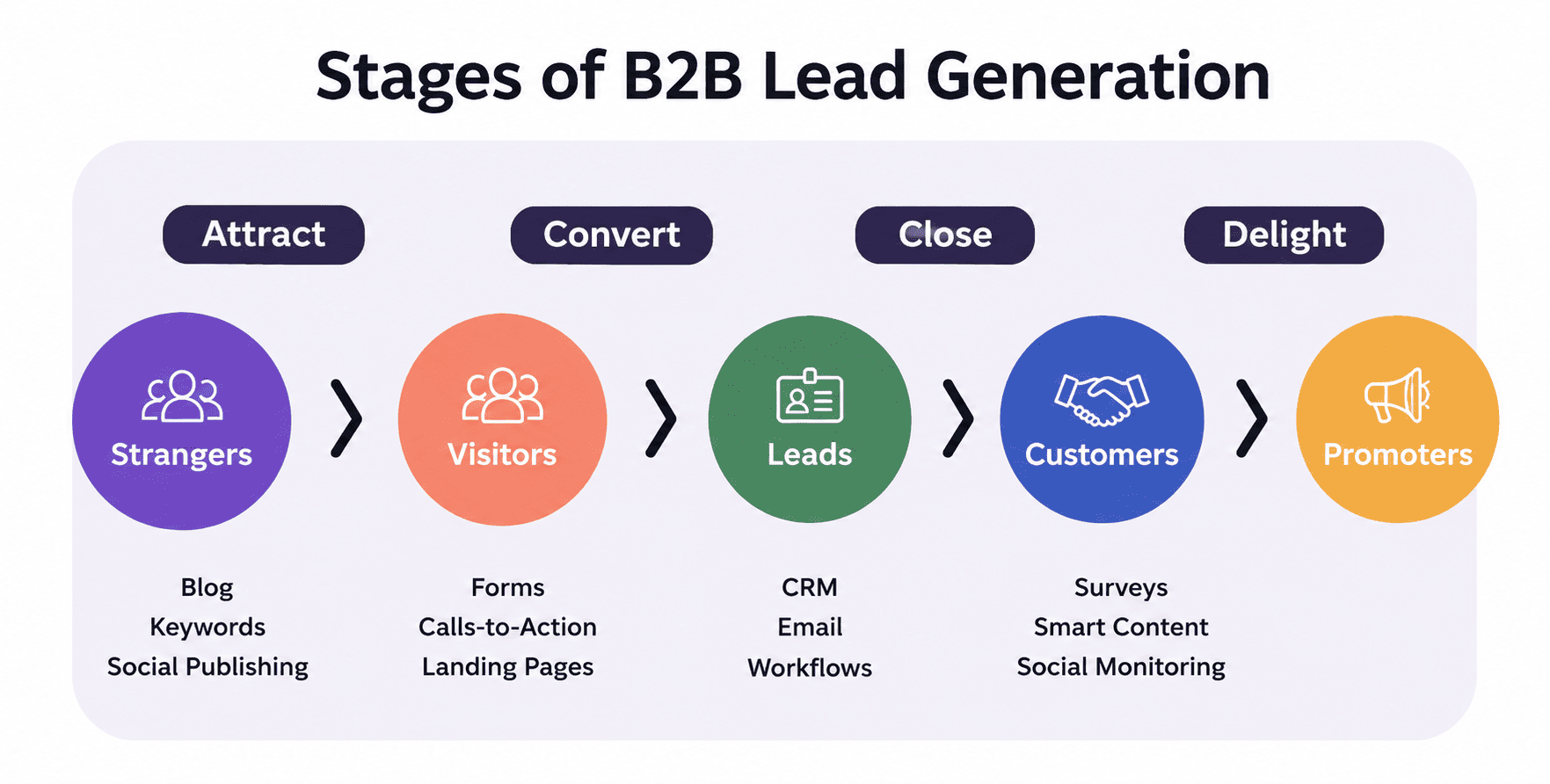
A practical B2B funnel can be divided into six stages.
Stage 1: Awareness
The buyer has a problem or business objective but may not know your company.
Useful channels:
- SEO
- Video
- Industry publications
- Research
- Events
- AI search
Stage 2: Research
The buyer is learning about possible solutions.
Useful content:
- Guides
- Educational articles
- Comparisons
- Webinars
- Reports
- FAQs
Stage 3: Evaluation
The buyer is comparing vendors.
Useful assets:
- Product pages
- Case studies
- Pricing
- Technical documentation
- Reviews
- Demonstrations
- Competitor comparisons
Stage 4: Qualification
Sales and marketing determine whether the opportunity is commercially suitable.
Consider:
- ICP fit
- Need
- Budget
- Authority
- Timing
- Technical requirements
- Procurement requirements
Stage 5: Sales opportunity
A qualified opportunity enters the sales pipeline.
Track:
- Opportunity value
- Probability
- Decision-makers
- Next action
- Expected close date
- Sales stage
Stage 6: Customer and expansion
Lead generation does not end when the contract is signed.
Customers can create:
- Renewals
- Upsells
- Cross-sells
- Referrals
- Reviews
- Case studies
- New account opportunities
B2B lead generation KPIs to track in 2026
A simple dashboard might look like this:
|
KPI |
What it tells you |
|
Leads |
Volume entering the system |
|
MQLs |
Leads meeting marketing criteria |
|
SQLs |
Leads accepted by sales |
|
MQL-to-SQL rate |
Lead quality and qualification |
|
SQL-to-opportunity rate |
Sales qualification quality |
|
Opportunity-to-customer rate |
Sales effectiveness |
|
Cost per lead |
Acquisition efficiency |
|
CAC |
Cost of acquiring customers |
|
Pipeline generated |
Commercial value of marketing |
|
Sales cycle |
Speed of revenue generation |
|
Win rate |
Quality of opportunities |
|
Revenue by channel |
Which channels actually matter |
Conclusion
B2B lead generation in 2026 is not about collecting the highest number of leads; it is about finding the right companies, understanding their needs and reaching them at the right time.
A strong strategy combines a clear ICP, useful SEO content, LinkedIn, account-based marketing, accurate data, intent signals, email, sales outreach and AI-powered automation. The focus should always be on lead quality, meaningful conversations and qualified sales opportunities rather than volume alone.
The most successful B2B companies will connect marketing and sales into one process identify the right prospects, provide useful information, build trust, recognise buying signals, engage at the right moment and measure the journey through to revenue. When your content, website, data, sales team and technology work together, B2B lead generation becomes a predictable way to build a stronger pipeline and win the customers that matter most.
Frequently asked questions
Measure qualified opportunities and revenue rather than lead volume alone.
Google continues to recommend helpful, reliable, people-first content.
Contact us to get a digital strategy
Contact us for digital strategy guidance.